Fibromyalgia: A Real Condition, Not Just in Your Head — When the Nervous System Is Hypersensitive to Pain
Last updated: 14 Sept 2026

Fibromyalgia: The Pain Is Real, Not Just "In Your Head"
Fibromyalgia: A Central Sensitization and Nociplastic Pain Approach
"Doctor, my blood tests are normal, and the MRI showed nothing. Why am I still in so much pain?" This is one of the most common questions from individuals living with fibromyalgia. The absence of visible abnormalities often leaves patients feeling confused, exhausted, or invalidated by others who assume their symptoms are merely psychological or stress-induced.
Historically, the medical community frequently categorized this condition as primarily psychosomatic because routine imaging and lab work revealed no clear structural tissue damage. Over the past two decades, modern neuroscience along with headache and pain medicine has firmly established that fibromyalgia is a real, measurable neurobiological disorder. It stems from altered pain processing within the central nervous system (the brain and spinal cord)—not an imagined illness.
Q&A: What Is Fibromyalgia and How Common Is It?
What is Fibromyalgia?
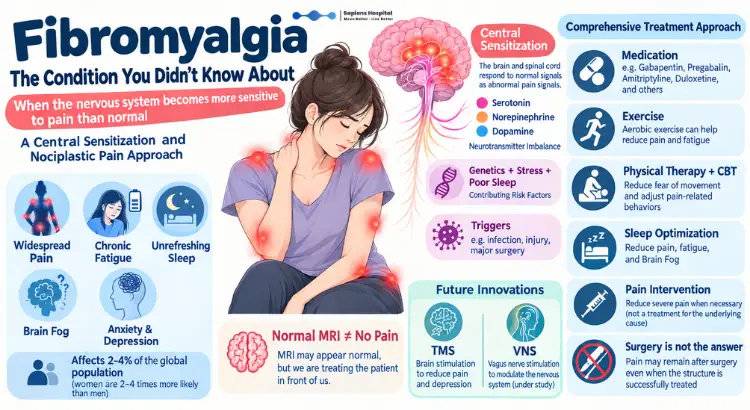
Fibromyalgia is classified as a nociplastic pain syndrome. This means the pain arises from altered nociceptive processing and central nervous system dysregulation, rather than ongoing tissue inflammation or direct structural damage. Core clinical features include:
Fibromyalgia affects approximately 2% to 4% of the global population. It is clinically diagnosed two to four times more often in women than in men, typically emerging during working-age adulthood. Current evidence suggests men may be underdiagnosed due to differences in symptom presentation and diagnostic criteria application.
Clinical Features and Overlapping Conditions
Fibromyalgia is multifactorial, driven by interconnected neurobiological alterations:
Comprehensive Multidisciplinary Management
Because fibromyalgia is rooted in central pain processing rather than isolated local injury, there is no single procedure or surgery that can cure it. Effective management focuses on dampening nervous system hypersensitivity, controlling symptoms, and restoring daily functional capacity through an integrated care plan:
1. Pharmacotherapy
References
Häuser W, Ablin J, Fitzcharles MA, Littlejohn G, Luciano JV, Usui C, et al. Fibromyalgia. Nature Reviews Disease Primers. 2015;1:15022. doi:10.1038/nrdp.2015.22.
Clauw DJ. Fibromyalgia: A Clinical Review. JAMA. 2014;311(15):1547-1555. doi:10.1001/jama.2014.3266.
Fitzcharles MA, Cohen SP, Clauw DJ, Littlejohn G, Usui C, Häuser W. Nociplastic pain: towards an understanding of prevalent pain conditions. Lancet. 2021;397(10289):2098-2110.
Wolfe F, Clauw DJ, Fitzcharles MA, Goldenberg DL, Häuser W, Katz RL, et al. 2016 Revisions to the 2010/2011 Fibromyalgia Diagnostic Criteria. Seminars in Arthritis and Rheumatism. 2016;46(3):319-329.
Macfarlane GJ, Kronisch C, Dean LE, Atzeni F, Häuser W, Fluß E, et al. EULAR revised recommendations for the management of fibromyalgia. Annals of the Rheumatic Diseases. 2017;76(2):318-328. doi:10.1136/annrheumdis-2016-209724.
Häuser W, Perrot S, Sommer C, Shir Y, Fitzcharles MA. Diagnostic confounders of chronic widespread pain: not always fibromyalgia. Pain Reports. 2017;2(3):e598.
Häuser W, Sarzi-Puttini P, Fitzcharles MA. Fibromyalgia syndrome: under-, over- and misdiagnosis. Clinical and Experimental Rheumatology. 2019;37 Suppl 116(1):90-97.
Bidonde J, Busch AJ, Schachter CL, Webber SC, Musselman KE, Overend TJ, et al. Aerobic exercise training for adults with fibromyalgia. Cochrane Database of Systematic Reviews. 2017;6:CD012700.
Busch AJ, Webber SC, Richards RS, Bidonde J, Schachter CL, Schafer LA, et al. Resistance exercise training for fibromyalgia. Cochrane Database of Systematic Reviews. 2013;12:CD010884.
Zhu CE, Yu B, Zhang W, Chen WH, Qi Q, Miao Y. Effectiveness of transcranial magnetic stimulation in fibromyalgia: a systematic review and meta-analysis. The Clinical Journal of Pain. 2021;37(5):385-394.
Brummett CM, Urquhart AG, Hassett AL, Tsodikov A, Hallstrom BR, Wood NI, et al. Characteristics of fibromyalgia independently predict poorer long-term analgesic outcomes following total knee and hip arthroplasty. Arthritis & Rheumatology. 2015;67(5):1386-1394.
International Association for the Study of Pain. IASP Terminology: Nociplastic Pain. International Association for the Study of Pain; updated terminology.
Fibromyalgia: A Central Sensitization and Nociplastic Pain Approach
"Doctor, my blood tests are normal, and the MRI showed nothing. Why am I still in so much pain?" This is one of the most common questions from individuals living with fibromyalgia. The absence of visible abnormalities often leaves patients feeling confused, exhausted, or invalidated by others who assume their symptoms are merely psychological or stress-induced.
Historically, the medical community frequently categorized this condition as primarily psychosomatic because routine imaging and lab work revealed no clear structural tissue damage. Over the past two decades, modern neuroscience along with headache and pain medicine has firmly established that fibromyalgia is a real, measurable neurobiological disorder. It stems from altered pain processing within the central nervous system (the brain and spinal cord)—not an imagined illness.
Q&A: What Is Fibromyalgia and How Common Is It?
What is Fibromyalgia?
Fibromyalgia is classified as a nociplastic pain syndrome. This means the pain arises from altered nociceptive processing and central nervous system dysregulation, rather than ongoing tissue inflammation or direct structural damage. Core clinical features include:
- Chronic widespread pain distributed throughout multiple areas of the body.
- Chronic fatigue, marked by persistent exhaustion even without strenuous physical activity.
- Non-restorative sleep, characterized by difficulty achieving deep sleep, frequent awakenings, and waking up unrefreshed despite adequate sleeping hours.
- Brain fog, involving mental sluggishness, forgetfulness, reduced focus, short-term memory lapses, and slowed processing speed.
- Coexisting mood disorders, frequently presenting with elevated anxiety or depression.
Fibromyalgia affects approximately 2% to 4% of the global population. It is clinically diagnosed two to four times more often in women than in men, typically emerging during working-age adulthood. Current evidence suggests men may be underdiagnosed due to differences in symptom presentation and diagnostic criteria application.
Clinical Features and Overlapping Conditions
- Pain Distribution and Patterns: Discomfort is typically widespread, most prominent in the neck, shoulders, upper back, lower back, hips, and extremities. Many patients first seek medical care for persistent neck or low back pain and are mistakenly managed for extended periods under diagnoses like office syndrome or localized degenerative disc disease.
- Heightened Pain Sensitivity: Patients frequently exhibit hyperalgesia (an exaggerated response to normally painful stimuli) and allodynia (pain provoked by stimuli that do not typically cause pain). Common triggers for flares include light skin touch or pressure, prolonged sitting or standing, tight-fitting clothing, and rapid weather fluctuations.
- Associated Comorbidities: Fibromyalgia frequently overlaps with other chronic pain disorders, such as migraines, irritable bowel syndrome (IBS), chronic pelvic pain, interstitial cystitis, temporomandibular disorders (TMD), chronic fatigue syndrome (ME/CFS), and post-acute sequelae of COVID-19 (Long COVID). It can also coexist with autoimmune disorders such as rheumatoid arthritis, systemic lupus erythematosus, and Sjögren’s syndrome, although fibromyalgia itself is not classified as an autoimmune condition.
Fibromyalgia is multifactorial, driven by interconnected neurobiological alterations:
- Central Sensitization (The Core Mechanism): The brain and spinal cord become hyper-responsive to sensory input. Neural circuits amplify signals like an internal "volume knob" turned up too high, causing routine sensory information to register as pain.
- Neurotransmitter Imbalances: Studies show dysregulation in key neurotransmitters—including serotonin, norepinephrine, and dopamine—which modulate descending pain inhibition pathways, mood regulation, and restorative sleep cycles.
- Genetic Predisposition and Chronic Stress: A familial history of chronic pain conditions is common. Prolonged psychosocial stress, chronic sleep disruption, or poor deep-wave sleep suppresses growth hormone release and limits tissue recovery.
- Precipitating Triggers: The onset of symptoms is often preceded by a distinct physical or systemic stressor, such as a viral infection (e.g., COVID-19), major physical trauma, or extensive surgery.
- If there is no definitive diagnostic test, why perform blood work or an MRI?
While no single laboratory or imaging test can independently confirm fibromyalgia, diagnostic workups remain essential. Their primary clinical objective is to rule out alternative or coexisting conditions that mimic these symptoms, such as vitamin D deficiency, thyroid dysfunction, anemia, neurological deficits, or systemic autoimmune rheumatic diseases.
- Do normal or abnormal MRI scans tell the full story?
Not necessarily. Many individuals with fibromyalgia have MRI scans that reveal mild or moderate degenerative changes in the cervical or lumbar spine; however, these localized anatomical findings cannot account for diffuse, widespread pain. Conversely, another individual may have noticeable structural wear on imaging while experiencing minimal discomfort.
Comprehensive Multidisciplinary Management
Because fibromyalgia is rooted in central pain processing rather than isolated local injury, there is no single procedure or surgery that can cure it. Effective management focuses on dampening nervous system hypersensitivity, controlling symptoms, and restoring daily functional capacity through an integrated care plan:
1. Pharmacotherapy
- Core Neuromodulators: Medications targeting nerve pain pathways and neurotransmitter activity—such as gabapentin, pregabalin, amitriptyline, and duloxetine—help dampen pain transmission and improve restorative sleep.
- Clinical Considerations with Mirogabalin: A significant portion of patients struggle with the side effects of higher-dose pregabalin (300–450 mg/day), reporting excessive daytime sedation, dizziness, or exacerbated cognitive fog. Switching to newer alpha-2-delta ligands, such as mirogabalin, can offer a more tolerable profile for selected patients, facilitating better dose titration and symptom control.
- Aerobic conditioning holds the strongest clinical evidence for fibromyalgia management. Low-impact activities—such as brisk walking, swimming, aquatic therapy, and stationary cycling—consistently reduce fatigue, improve sleep quality, and lower long-term pain scores.
- Precaution: Exercise regimens must follow a "start low, go slow" approach. Pushing through severe fatigue or overexerting too quickly can trigger significant symptom flares, often leading to total cessation of activity.
- Physical Therapy: Therapy does not target muscle damage; rather, it aims to break the cycle of kinesiophobia (fear of movement). Avoiding physical activity leads to progressive deconditioning, worsening fatigue, and heightened sensitivity. Structured movement rebuilds stamina and confidence.
- Cognitive Behavioral Therapy (CBT): Psychological support helps patients explore how stress, autonomic arousal, and pain perception interact, providing practical coping frameworks to manage symptom volatility.
- Sleep Hygiene Optimization: Implementing structured sleep protocols directly targets non-restorative sleep, helping relieve chronic fatigue, muscle soreness, and cognitive clouding.
- Targeted Interventions: Targeted injections or nerve blocks (such as epidural steroid injections, facet joint interventions, sacroiliac joint blocks, or trigger point injections) are reserved strictly for discrete, structural pain generators occurring alongside fibromyalgia. Relieving a severe, localized source of pain lowers baseline nervous system activation, making it easier for patients to participate in rehabilitation and sleep restoratively.
- Surgical Considerations: Fibromyalgia itself is not an indication for surgery. Multiple studies caution that individuals with underlying central sensitization and nociplastic pain are at a substantially higher risk of persistent, widespread post-surgical pain—even when the structural operation (such as spine surgery, total knee arthroplasty, or total hip arthroplasty) is technically successful. Comprehensive pre-operative evaluation is crucial to set realistic expectations and optimize pain processing beforehand.
- Transcranial Magnetic Stimulation (TMS): Utilizes targeted magnetic pulses to stimulate cortical areas responsible for central pain modulation and mood regulation, showing utility for refractory pain and secondary depression.
References
Häuser W, Ablin J, Fitzcharles MA, Littlejohn G, Luciano JV, Usui C, et al. Fibromyalgia. Nature Reviews Disease Primers. 2015;1:15022. doi:10.1038/nrdp.2015.22.
Clauw DJ. Fibromyalgia: A Clinical Review. JAMA. 2014;311(15):1547-1555. doi:10.1001/jama.2014.3266.
Fitzcharles MA, Cohen SP, Clauw DJ, Littlejohn G, Usui C, Häuser W. Nociplastic pain: towards an understanding of prevalent pain conditions. Lancet. 2021;397(10289):2098-2110.
Wolfe F, Clauw DJ, Fitzcharles MA, Goldenberg DL, Häuser W, Katz RL, et al. 2016 Revisions to the 2010/2011 Fibromyalgia Diagnostic Criteria. Seminars in Arthritis and Rheumatism. 2016;46(3):319-329.
Macfarlane GJ, Kronisch C, Dean LE, Atzeni F, Häuser W, Fluß E, et al. EULAR revised recommendations for the management of fibromyalgia. Annals of the Rheumatic Diseases. 2017;76(2):318-328. doi:10.1136/annrheumdis-2016-209724.
Häuser W, Perrot S, Sommer C, Shir Y, Fitzcharles MA. Diagnostic confounders of chronic widespread pain: not always fibromyalgia. Pain Reports. 2017;2(3):e598.
Häuser W, Sarzi-Puttini P, Fitzcharles MA. Fibromyalgia syndrome: under-, over- and misdiagnosis. Clinical and Experimental Rheumatology. 2019;37 Suppl 116(1):90-97.
Bidonde J, Busch AJ, Schachter CL, Webber SC, Musselman KE, Overend TJ, et al. Aerobic exercise training for adults with fibromyalgia. Cochrane Database of Systematic Reviews. 2017;6:CD012700.
Busch AJ, Webber SC, Richards RS, Bidonde J, Schachter CL, Schafer LA, et al. Resistance exercise training for fibromyalgia. Cochrane Database of Systematic Reviews. 2013;12:CD010884.
Zhu CE, Yu B, Zhang W, Chen WH, Qi Q, Miao Y. Effectiveness of transcranial magnetic stimulation in fibromyalgia: a systematic review and meta-analysis. The Clinical Journal of Pain. 2021;37(5):385-394.
Brummett CM, Urquhart AG, Hassett AL, Tsodikov A, Hallstrom BR, Wood NI, et al. Characteristics of fibromyalgia independently predict poorer long-term analgesic outcomes following total knee and hip arthroplasty. Arthritis & Rheumatology. 2015;67(5):1386-1394.
International Association for the Study of Pain. IASP Terminology: Nociplastic Pain. International Association for the Study of Pain; updated terminology.
Related Content

Unnecessary surgery can carry risks and complications such as scar tissue, fibrosis, and a cycle of endless treatment. Furthermore, it is often unsuitable for individuals with underlying medical conditions. Read this before undergoing the knife, as the risks may far outweigh the benefits.
2 Aug 2025

ปวดหลัง ออฟฟิศซินโดรม จากการทำงานนานๆ อาจส่งผลเสียต่อสุขภาพ รู้จักสาเหตุ อาการ และแนวทางป้องกัน พร้อมวิธีรักษาเพื่อให้ร่างกายกลับมาแข็งแรงอีกครั้ง
18 Apr 2025

90 years old patient concerned to get treatment for back pain and neck pain. The seek of the right and compassionate doctor is more challenging than the treatment.
28 Apr 2026
