Persistent Spinal Pain Syndrome Type 2 (PSPS Type 2) / Failed Back Surgery Syndrome (FBSS)
Last updated: 14 Sept 2026
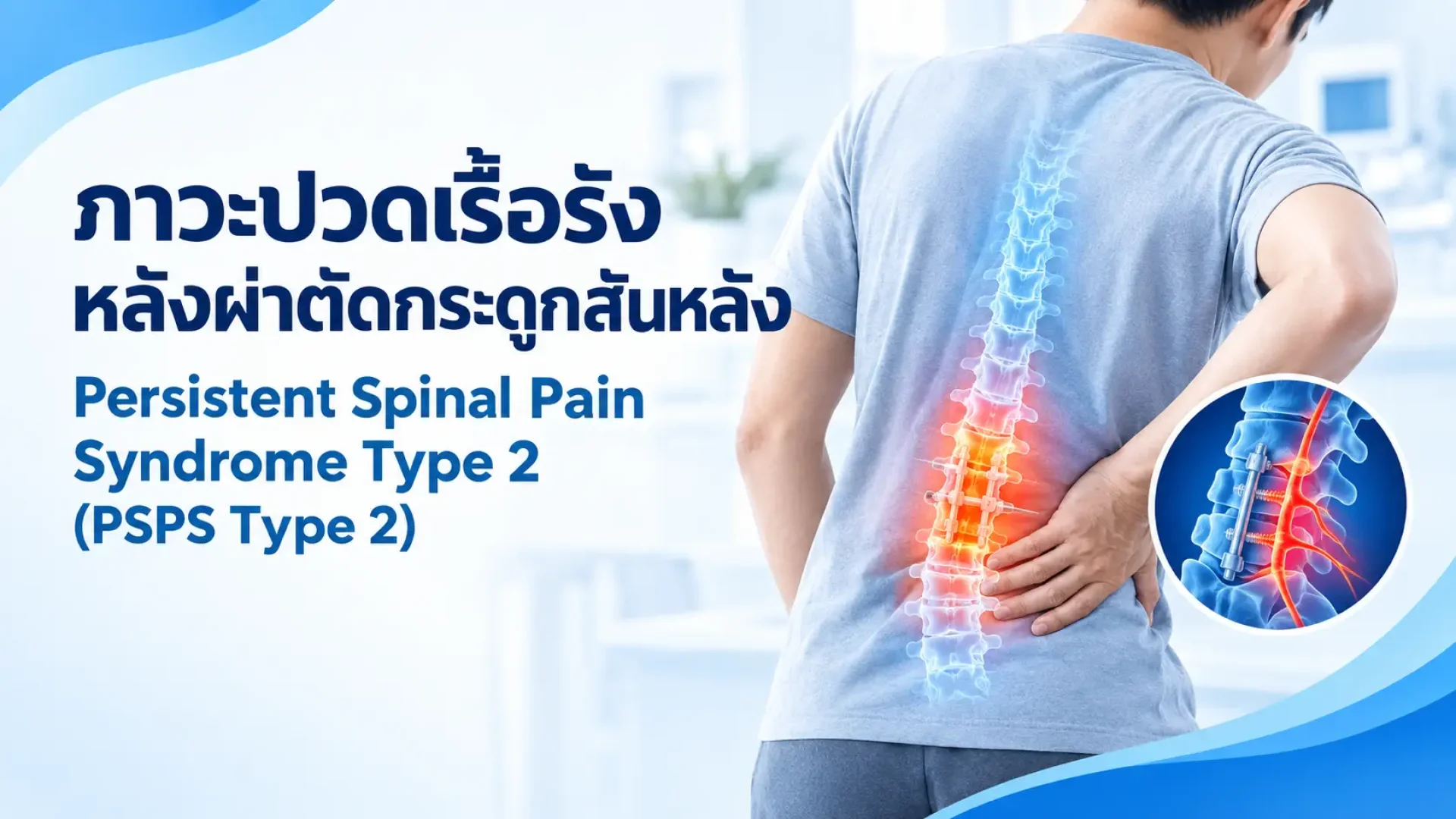
Persistent Spinal Pain Syndrome Type 2 (PSPS Type 2)
Persistent Spinal Pain Syndrome Type 2 (PSPS Type 2) / Failed Back Surgery Syndrome (FBSS)
It is a common belief that spine surgery provides an absolute cure. In reality, a significant number of patients continue to experience chronic pain after surgery, or notice their symptoms returning after a brief period of initial relief. Historically, this condition was termed Failed Back Surgery Syndrome (FBSS).
Today, spine specialists and pain physicians predominantly use the term Persistent Spinal Pain Syndrome Type 2 (PSPS Type 2). This updated nomenclature emphasizes that persistent symptoms do not inherently signify surgical failure or technical error. Instead, ongoing post-surgical pain typically stems from a multifactorial interplay involving nerves, facet joints, surrounding musculature, and pathological changes in pain processing pathways.
Q&A: Epidemiology and Procedure-Specific Risks
How common is PSPS Type 2?
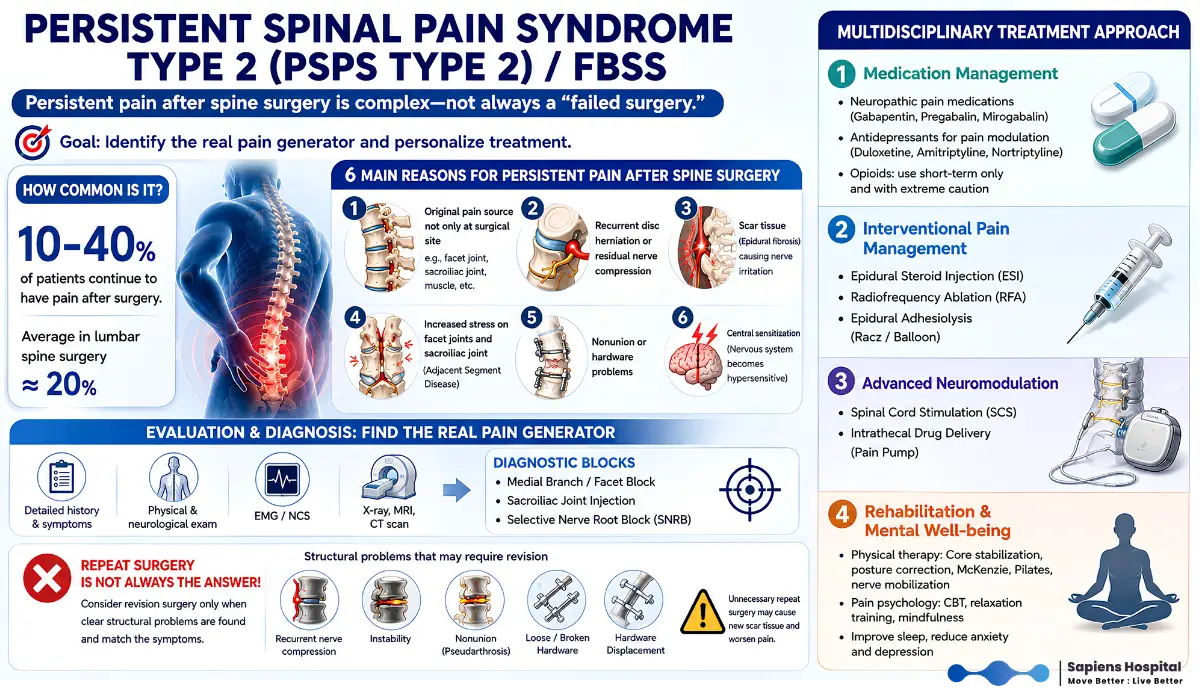
Despite advances in surgical techniques, no spinal procedure can guarantee a 100% cure rate. Studies report that 10% to 40% of patients experience persistent or recurrent pain following spinal interventions, with an average incidence of approximately 20% after lumbar spine procedures. Risk factors include the type of surgery, preoperative disease chronicity and complexity, underlying comorbidities, sleep disturbances, and baseline psychological distress.
Does the risk vary by surgical procedure?
The primary clinical objective in PSPS Type 2 is identifying the exact pain generator. The assessment involves a comprehensive history, neurological evaluation, gait and balance analysis, electrodiagnostic testing (EMG/NCS), and dynamic imaging studies (weight-bearing X-rays, CT scans, and contrast-enhanced MRI to distinguish scar tissue from recurrent herniation).
When clinical imaging is inconclusive, diagnostic interventional blocks are deployed to pinpoint the anatomical source:
Contemporary clinical guidelines prioritize personalized, multidisciplinary care over immediate revision surgery:
1. Pharmacotherapy
Revision surgery is not universally indicated. A repeat surgical procedure should be reserved strictly for clear, demonstrable structural pathology that matches the patient's objective neurological findings—such as high-grade neural compression, acute mechanical instability, pseudarthrosis, or hardware failure.
In the absence of a surgically remediable structural lesion, exploratory or unindicated revision operations yield diminishing returns. They risk generating further epidural fibrosis, worsening central sensitization, and compounding overall clinical complexity.
References
Cho JH, Lee JH, Song KS, et al. Failed back surgery syndrome-terminology, etiology, prevention, evaluation, and management: a narrative review. Yeungnam Univ J Med. 2024.
Patel K, Upadhyayula S. Failed Back Surgery Syndrome. StatPearls Publishing. Updated 2024.
Thomson S. Failed back surgery syndrome - definition, epidemiology and demographics. Br J Pain. 2013;7(1):56-59.
Prevalence of Chronic Pain After Spinal Surgery: A Systematic Review and Meta-analysis. Cureus. 2023.
International Association for the Study of Pain (IASP). Classification of chronic pain after spinal surgery.
Goldstein CL, et al. Perioperative outcomes and adverse events of minimally invasive versus open posterior lumbar fusion: meta-analysis and systematic review. J Neurosurg Spine. 2016.
Qu J, et al. Comparison of minimally invasive versus open transforaminal lumbar interbody fusion in degenerative lumbar diseases: a meta-analysis. Eur Spine J. 2015.
Harrop JS, et al. Adjacent segment degeneration after lumbar fusion: a review of clinical, biomechanical, and radiologic studies. Am J Orthop. 2008.
Witkam RL, Buckens CFM, Van Goethem J, Henssen D. The current role and future directions of imaging in failed back surgery syndrome patients: an educational review. Insights Imaging. 2022.
Woolf CJ. Central sensitization: implications for the diagnosis and treatment of pain. Pain. 2011.
Nijs J, et al. Treatment of central sensitization in patients with chronic pain. Pain Physician. 2014.
Manchikanti L, et al. Effectiveness of percutaneous adhesiolysis in post lumbar surgery syndrome. Pain Physician. 2021.
Kapural L, et al. Novel 10-kHz High-frequency Therapy (HF10 Therapy) Is Superior to Traditional Low-frequency Spinal Cord Stimulation for the Treatment of Chronic Back and Leg Pain. Anesthesiology. 2015.
Deer TR, et al. A systematic literature review of spinal cord stimulation complications. Pain Med. 2014.
Kumar K, Taylor RS, Jacques L, et al. Spinal cord stimulation versus conventional medical management for neuropathic pain. Pain. 2007.
North RB, et al. Spinal cord stimulation versus repeated lumbosacral spine surgery for chronic pain. Neurosurgery. 2005.
Persistent Spinal Pain Syndrome Type 2 (PSPS Type 2) / Failed Back Surgery Syndrome (FBSS)
It is a common belief that spine surgery provides an absolute cure. In reality, a significant number of patients continue to experience chronic pain after surgery, or notice their symptoms returning after a brief period of initial relief. Historically, this condition was termed Failed Back Surgery Syndrome (FBSS).
Today, spine specialists and pain physicians predominantly use the term Persistent Spinal Pain Syndrome Type 2 (PSPS Type 2). This updated nomenclature emphasizes that persistent symptoms do not inherently signify surgical failure or technical error. Instead, ongoing post-surgical pain typically stems from a multifactorial interplay involving nerves, facet joints, surrounding musculature, and pathological changes in pain processing pathways.
Q&A: Epidemiology and Procedure-Specific Risks
How common is PSPS Type 2?
Despite advances in surgical techniques, no spinal procedure can guarantee a 100% cure rate. Studies report that 10% to 40% of patients experience persistent or recurrent pain following spinal interventions, with an average incidence of approximately 20% after lumbar spine procedures. Risk factors include the type of surgery, preoperative disease chronicity and complexity, underlying comorbidities, sleep disturbances, and baseline psychological distress.
Does the risk vary by surgical procedure?
- Minimally Invasive Spine Surgery / Microdiscectomy: While highly effective for radiating leg pain (radiculopathy) caused by nerve root compression, roughly 10% to 20% of patients report persistent or recurrent pain. Common drivers include recurrent disc herniation or persistent neuropathic pain hypersensitivity.
- Spinal Fusion Surgery: Indicated for spinal instability, spondylolisthesis, or severe multilevel degeneration. Due to its surgical invasiveness and complexity, chronic post-surgical pain rates range between 20% and 40%, with higher risks observed in multilevel fusions and revision surgeries.
- Extraspinal or Multiple Coexisting Pain Generators: The initial imaging might show marked disc herniation, but concurrent pain generators—such as the facet joints, sacroiliac (SI) joints, or myofascial structures—may have been present prior to surgery. Correcting the anatomical defect seen on MRI does not resolve pain originating from these unaddressed structures.
- Recurrent Disc Herniation or Residual Neural Compression: Discs can re-herniate at the operated level or an adjacent segment, especially if severe radicular pain reoccurs shortly after an asymptomatic postoperative window.
- Epidural Fibrosis (Postoperative Scar Tissue): While scar formation is a normal physiological healing response, excessive fibrotic tissue can tether, compress, or chronically irritate nerve roots. Patients characteristically experience initial pain relief followed by a gradual onset of burning, numbness, or shooting pain within 1 to 3 months post-op.
- Adjacent Segment Disease (ASD): Rigid spinal fusion alters normal biomechanics, transferring excessive mechanical stress and rotational forces onto adjacent unfused vertebrae. Over time, this accelerates adjacent facet joint and disc degeneration.
- Pseudarthrosis or Hardware Complications: Failure of the bone graft to fuse completely (pseudarthrosis), screw loosening, rod fracture, or hardware migration can provoke progressive, mechanical back pain.
- Central Sensitization: Patients who suffered prolonged, severe pain prior to surgery often develop neuroplastic alterations where the central nervous system amplifies and sustains pain signals. Even after surgical decompression, patients may experience allodynia, widespread burning sensations, sleep fragmentation, hyperalgesia, and heightened anxiety or depression.
The primary clinical objective in PSPS Type 2 is identifying the exact pain generator. The assessment involves a comprehensive history, neurological evaluation, gait and balance analysis, electrodiagnostic testing (EMG/NCS), and dynamic imaging studies (weight-bearing X-rays, CT scans, and contrast-enhanced MRI to distinguish scar tissue from recurrent herniation).
When clinical imaging is inconclusive, diagnostic interventional blocks are deployed to pinpoint the anatomical source:
- Medial Branch Block / Facet Joint Injections: Evaluates pain originating from the zygapophysial joints (common following spinal fusion).
- Sacroiliac Joint (SIJ) Injections: Clarifies buttock, groin, and lower back pain associated with altered pelvic biomechanics.
- Selective Nerve Root Block (SNRB): Identifies the exact spinal nerve root responsible for dermatomal radicular symptoms.
Contemporary clinical guidelines prioritize personalized, multidisciplinary care over immediate revision surgery:
1. Pharmacotherapy
- Neuropathic Pain Agents: First-line medications targeting nerve pain pathways (Gabapentin, Pregabalin, Mirogabalin).
- SNRIs and TCAs: Modulate descending pain-inhibitory pathways (Duloxetine, Amitriptyline, Nortriptyline).
- Caution on Opioids: Long-term opioid therapy must be strictly restricted. Beyond dependence, tolerance, and sedation, chronic opioid exposure often triggers opioid-induced hyperalgesia (OIH), paradoxical worsening of pain sensitivity.
- Epidural Steroid Injections (ESI): Target radicular inflammatory cascades via interlaminar, transforaminal, or caudal approaches.
- Radiofrequency Ablation (RFA): Applies targeted thermal energy to disrupt sensory nerve signals (medial branches or lateral branches), providing durable relief for 6 to 18 months in facet- or SI joint-mediated pain.
- Percutaneous Epidural Adhesiolysis (Racz Catheter / Balloon Neuroplasty): A targeted catheter or inflatable balloon is guided into the epidural space via the sacral hiatus to mechanically disrupt fibrotic scar tissue, decompress entrapped nerves, and deliver targeted anti-inflammatory agents.
- Spinal Cord Stimulation (SCS): Indicated for medically refractory neuropathic post-surgical pain. Electrodes implanted in the epidural space deliver electrical currents to the dorsal columns, inhibiting pain transmission to the brain. Advanced waveforms include High-Frequency (10-kHz), Burst, Differential Target Multiplexed (DTM), and Closed-Loop smart-sensing systems.
- Intrathecal Drug Delivery Systems (Targeted Drug Delivery / Pain Pump): Delivers micro-doses of medication directly into the intrathecal cerebrospinal fluid, reserved for severe, treatment-resistant pain profiles.
- Targeted Physical Therapy: Focuses on dynamic core stabilization, postural retraining, motor control restoration, McKenzie directional exercises, and gentle neural mobilization.
- Pain Psychology: Employs Cognitive Behavioral Therapy (CBT), acceptance-based approaches, and mindfulness-based stress reduction to recalibrate central autonomic processing, improve sleep architecture, and reduce catastrophizing.
Revision surgery is not universally indicated. A repeat surgical procedure should be reserved strictly for clear, demonstrable structural pathology that matches the patient's objective neurological findings—such as high-grade neural compression, acute mechanical instability, pseudarthrosis, or hardware failure.
In the absence of a surgically remediable structural lesion, exploratory or unindicated revision operations yield diminishing returns. They risk generating further epidural fibrosis, worsening central sensitization, and compounding overall clinical complexity.
References
Cho JH, Lee JH, Song KS, et al. Failed back surgery syndrome-terminology, etiology, prevention, evaluation, and management: a narrative review. Yeungnam Univ J Med. 2024.
Patel K, Upadhyayula S. Failed Back Surgery Syndrome. StatPearls Publishing. Updated 2024.
Thomson S. Failed back surgery syndrome - definition, epidemiology and demographics. Br J Pain. 2013;7(1):56-59.
Prevalence of Chronic Pain After Spinal Surgery: A Systematic Review and Meta-analysis. Cureus. 2023.
International Association for the Study of Pain (IASP). Classification of chronic pain after spinal surgery.
Goldstein CL, et al. Perioperative outcomes and adverse events of minimally invasive versus open posterior lumbar fusion: meta-analysis and systematic review. J Neurosurg Spine. 2016.
Qu J, et al. Comparison of minimally invasive versus open transforaminal lumbar interbody fusion in degenerative lumbar diseases: a meta-analysis. Eur Spine J. 2015.
Harrop JS, et al. Adjacent segment degeneration after lumbar fusion: a review of clinical, biomechanical, and radiologic studies. Am J Orthop. 2008.
Witkam RL, Buckens CFM, Van Goethem J, Henssen D. The current role and future directions of imaging in failed back surgery syndrome patients: an educational review. Insights Imaging. 2022.
Woolf CJ. Central sensitization: implications for the diagnosis and treatment of pain. Pain. 2011.
Nijs J, et al. Treatment of central sensitization in patients with chronic pain. Pain Physician. 2014.
Manchikanti L, et al. Effectiveness of percutaneous adhesiolysis in post lumbar surgery syndrome. Pain Physician. 2021.
Kapural L, et al. Novel 10-kHz High-frequency Therapy (HF10 Therapy) Is Superior to Traditional Low-frequency Spinal Cord Stimulation for the Treatment of Chronic Back and Leg Pain. Anesthesiology. 2015.
Deer TR, et al. A systematic literature review of spinal cord stimulation complications. Pain Med. 2014.
Kumar K, Taylor RS, Jacques L, et al. Spinal cord stimulation versus conventional medical management for neuropathic pain. Pain. 2007.
North RB, et al. Spinal cord stimulation versus repeated lumbosacral spine surgery for chronic pain. Neurosurgery. 2005.
Tags :
Related Content

อาการบาดเจ็บจากการเล่นกีฬาเกิดได้จากหลายปัจจัย รู้จักประเภทของอาการบาดเจ็บ วิธีรักษาเบื้องต้น และแนวทางป้องกัน เพื่อลดความเสี่ยงและกลับมาเล่นกีฬาได้ปกติ
18 Apr 2025

ออฟฟิศซินโดรมทำให้เกิดอาการปวดกล้ามเนื้อและเยื่อพังผืดที่คอ บ่าไหล่ และหลังจากการทำงานติดต่อกันหลายชั่วโมง
29 May 2025
This condition occurs when endometrial-like tissue grows outside the uterus, such as on the ovaries, fallopian tubes, pelvic tissue, or even the bowel or bladder.
31 Aug 2025
