Are ovarian cysts dangerous? When is monitoring or surgical intervention required?" Short & Direct
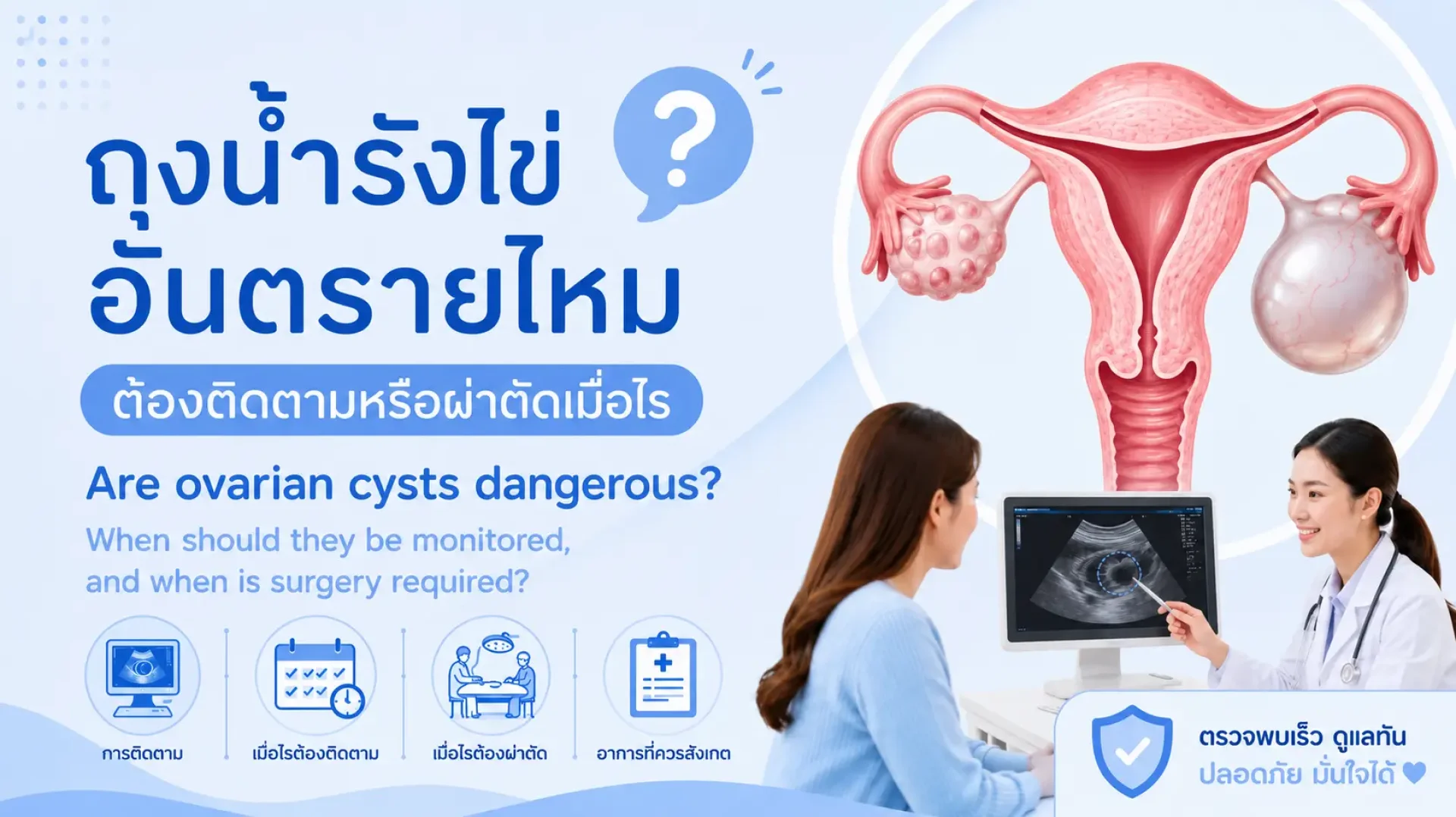
Are Ovarian Cysts Dangerous? When to Monitor and When to Consider Surgery
The term “ovarian cyst” often triggers immediate anxiety for many women when they hear it during an ultrasound result. Some discover it incidentally during an annual health check-up, while others present with unilateral pelvic pain or irregular periods. Many fear that the cyst will grow, rupture, twist, or turn into cancer.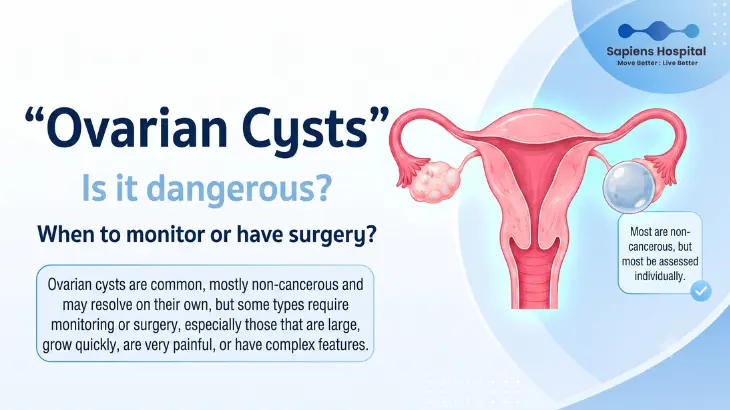
The good news is that the vast majority of ovarian cysts are not cancerous. In menstruating women, certain types of cysts develop naturally with the menstrual cycle and can resolve on their own without requiring surgery. The American College of Obstetricians and Gynecologists (ACOG) states that most ovarian cysts are benign and often disappear without specialized treatment.
However, it is crucial to note that not all cysts should be left unmonitored. Some cysts do not resolve on their own. Others may experience internal bleeding, present as endometriomas (chocolate cysts), develop into dermoid cysts, or show complex features that must be differentiated from ovarian tumors or cancer—especially in postmenopausal women or those experiencing abnormal symptoms.
Therefore, the most critical question is not simply "Do I have an ovarian cyst?" but rather: "What type of cyst is it? What is its size? How does it appear on the ultrasound? Are there any symptoms? And what is the patient's age?" The answers to these questions will determine whether the best course of action is to monitor, prescribe medication, or proceed with surgery.
What is an Ovarian Cyst?
An ovarian cyst is a fluid-filled or semi-solid sac that develops in or on an ovary. Some occur naturally as part of the menstrual cycle, some result from underlying conditions, and others may be distinct types of ovarian masses rather than simple cysts.
In women of reproductive age, the ovaries produce eggs and hormones. Each menstrual cycle, a follicle grows to prepare for ovulation. If the follicle fails to rupture or accumulates fluid, it can turn into a functional cyst, which is generally harmless and typically resolves independently.
Conversely, non-functional cysts—such as endometriomas, dermoid cysts, or cystadenomas—are not related to the menstrual cycle and may require monitoring or specific treatments based on their characteristics.
Note: The ACOG Practice Bulletin on adnexal masses emphasizes that the primary goal of evaluating pelvic masses is to distinguish benign cysts from those with a risk of malignancy and to determine whether a patient requires emergency surgery, elective surgery, or conservative monitoring.
Common Types of Ovarian Cysts
Understanding the type of cyst helps clarify why some resolve independently while others require medical intervention.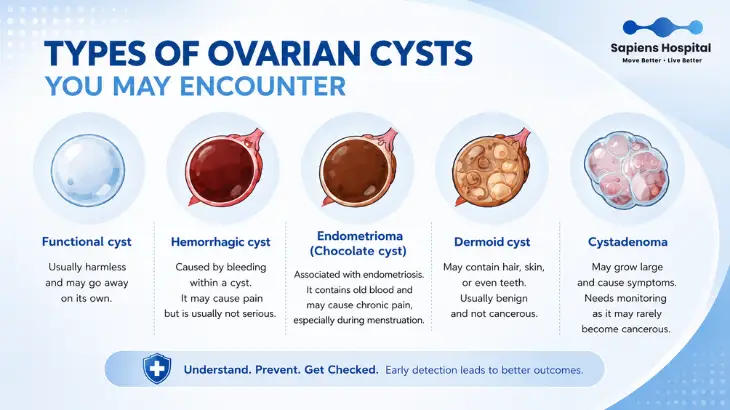
| Type of Cyst | Description | Key Characteristics |
| 1. Functional Cyst | Related to the menstrual cycle (e.g., follicular or corpus luteum cysts). | Usually asymptomatic, found incidentally, and typically resolves within a few cycles. |
| 2. Hemorrhagic Cyst | A cyst (often a corpus luteum cyst) with internal bleeding. | Can cause acute unilateral pelvic pain; often resolves, but severe cases need close monitoring. |
| 3. Endometrioma | Associated with endometriosis; contains old blood resembling chocolate. | Can cause severe menstrual cramps, chronic pelvic pain, painful intercourse, or infertility. |
| 4. Dermoid Cyst | A benign tumor containing tissues like fat, hair, or teeth. | Found in women of reproductive age; carries a risk of ovarian torsion if it grows large. |
| 5. Cystadenoma | A mass developing from ovarian tissue containing clear fluid or mucus. | Can grow quite large, pressing on nearby organs, often requiring surgical removal. |
| 6. Complex Mass | A mass with suspicious features on an ultrasound. |
May have thick walls, multiple compartments, solid areas, or high blood flow (assessed via ACR O-RADS).
|
Symptoms of Ovarian Cysts
While a large number of ovarian cysts cause no symptoms and are found incidentally via ultrasound, those that do cause symptoms may present as follows:
- Unilateral pelvic pain
- A dull, heavy ache in the lower abdomen or pelvis
- Bloating, fullness, or a feeling of an enlarged abdomen
- Pain during sexual intercourse
- Increased menstrual cramps or irregular periods
- Frequent urination (if the cyst presses on the bladder)
- Difficulty with bowel movements (if the cyst presses on the bowels)
- Sudden, severe pain (if the cyst ruptures or causes ovarian torsion)
Are Ovarian Cysts Dangerous?
The danger level depends entirely on the type, size, physical characteristics, age, and symptoms of the patient.
Small, smooth, clear, fluid-filled cysts with no thick walls or solid parts in menstruating women are usually simple cysts that can just be monitored. However, doctors exercise elevated caution if the cyst presents with the following features:
- Large or rapidly growing in size
- Complex features or solid components
- Papillary projections or nodules inside the cyst
- Thick walls or multiple dividing compartments (septations)
- Presence of fluid in the abdominal cavity (ascites)
- Occurrence in postmenopausal women
- Accompanied by severe or acute pain
- A family history of ovarian or breast cancer
- Abnormal tumor marker levels combined with suspicious ultrasound findings
Some ovarian cysts can lead to medical emergencies, such as a ruptured cyst, internal bleeding, or ovarian torsion (twisting of the ovary). Seek immediate medical attention if you experience:
- Sudden, severe pelvic pain
- Extreme pain localized to one side
- Severe nausea and vomiting accompanied by pelvic pain
- Dizziness, fainting, palpitations, or pale skin
- Abdominal pain accompanied by a fever
- A rigid, hard, or highly tender abdomen
- Suspected pregnancy or a missed period with abdominal pain or bleeding
- Pain so severe that it prevents walking or moving
Diagnostic Steps for Ovarian Cysts
When a cyst is suspected, your doctor will tailor the diagnostic process based on your age, symptoms, pregnancy status, and risk factors.
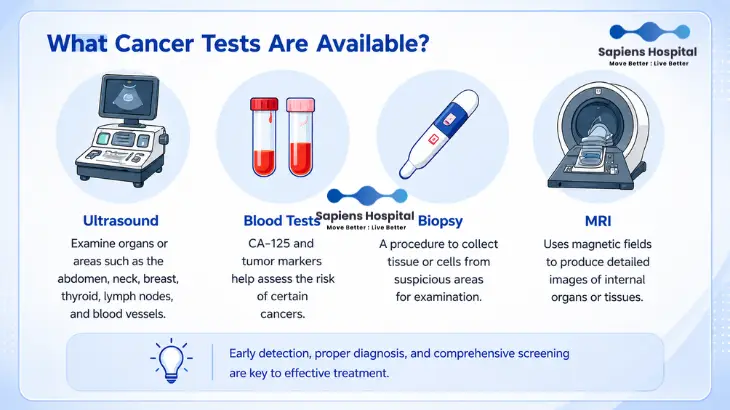
- Medical History and Physical Exam: Your doctor will ask when symptoms began, their severity, relation to your menstrual cycle, and any family history of cancer.
- Pregnancy Test: For women of reproductive age experiencing pelvic pain or abnormal bleeding, this is essential to rule out an ectopic pregnancy.
- Transvaginal or Abdominal Ultrasound: The gold standard for assessing cyst size, shape, walls, blood flow, and identifying solid components. Systems like O-RADS US help standardize risk reporting.
- Blood Tests (CA-125 & Tumor Markers): May be used to assess cancer risk, particularly in postmenopausal women or complex cysts. However, CA-125 can also be elevated due to benign conditions like endometriosis or fibroids.
- MRI: Not required for everyone but highly useful for complex masses when an ultrasound is inconclusive, helping effectively plan surgical treatments.
Not all cysts require immediate surgery. Many simple or functional cysts, especially in women with active menstrual cycles, can be safely monitored via follow-up ultrasounds over a few weeks or months.
According to SRU Consensus guidelines, routine monitoring is highly appropriate for:
- Small, smooth, and simple cysts
- Functional cysts expected to resolve naturally
- Hemorrhagic cysts with mild symptoms and stable vital signs
- Small, asymptomatic endometriomas or dermoid cysts
- Monitoring must follow a strict medical plan to ensure the cyst is not growing or changing characteristics.
Surgery is generally considered if the cyst falls into one of the following categories:
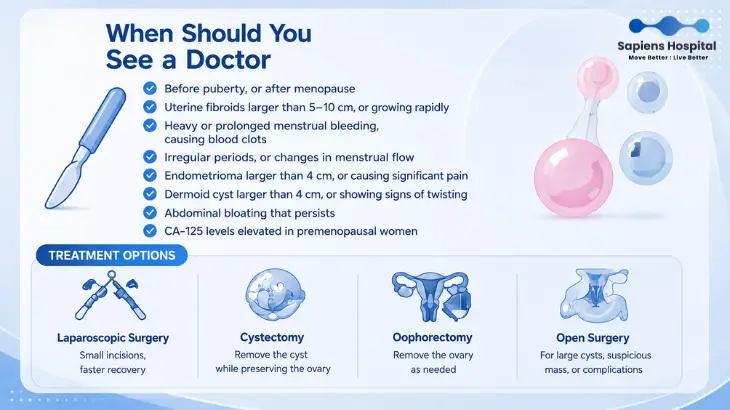
- Suspicious Characteristics: Complex features, solid parts, thick walls, or high blood flow indicating a higher risk of malignancy.
- Large or Continually Growing: Cysts larger than 10 cm or those pressing on other organs are at a higher risk of torsion and complications.
- Severe Pain or Complications: Emergencies like a ruptured cyst, internal bleeding, or ovarian torsion require immediate surgical intervention.
- Failure to Resolve: Functional cysts that do not shrink or disappear after a reasonable monitoring period.
- Symptomatic Endometriomas or Dermoid Cysts: Cysts causing chronic pain, infertility, or showing a risk of torsion.
- Postmenopausal Cysts with Red Flags: Increased risk of malignancy in postmenopausal women demands a more proactive surgical approach when suspicious signs are present.
- Cystectomy: Removal of the cyst while preserving the healthy ovarian tissue. Highly recommended for women of reproductive age wanting to maintain fertility.
- Oophorectomy: Removal of one or both ovaries. Usually considered for high-risk cysts, older patients, or when the cyst cannot be safely separated from the ovary.
- Laparoscopic Surgery (Minimally Invasive): The preferred method for most benign cysts. Offers smaller incisions, less pain, and faster recovery.
- Open Surgery (Laparotomy): Reserved for very large cysts, cases with severe scar tissue (adhesions), or suspected ovarian cancer to prevent the cyst from rupturing during removal.
While functional cysts do not generally impact fertility, conditions like endometriosis (chocolate cysts) can contribute to infertility. If you plan to have children, it is vital to inform your doctor, as any surgical intervention on the ovaries must be carefully planned to preserve your ovarian reserve (egg supply).
Postmenopausal Cysts
The risk of a cyst being malignant increases after menopause since functional cysts no longer naturally occur. While small, simple cysts may still just be monitored, doctors will utilize a combination of ultrasound, CA-125 blood tests, and rigorous risk assessments to ensure safety.
Self-Care While Monitoring a Cyst
If your doctor has recommended a watch-and-wait approach, please adhere to the following:
- Attend all scheduled ultrasound follow-ups.
- Monitor your pelvic pain levels.
- Go to the hospital immediately if you experience sudden, severe pain.
- Track your menstrual cycles and note any abnormalities.
- Inform your doctor about any irregular bleeding or spotting.
- Avoid taking unprescribed hormones or herbal supplements.
- Inform your healthcare provider if you are actively planning a pregnancy.
1. Is an ovarian cyst cancer?
Most are not cancerous, particularly in women of reproductive age. However, complex cysts, fast-growing cysts, or those found after menopause require a thorough evaluation to rule out malignancy.
2. Can an ovarian cyst go away on its own?
Yes. Functional cysts often resolve within a few menstrual cycles. However, non-functional types like dermoid cysts or endometriomas do not typically resolve and require monitoring or treatment.
3. At what size does a cyst need to be removed?
There is no single size rule. The decision depends on the cyst’s ultrasound characteristics, the patient's symptoms, age, and overall risk profile.
4. Does a high CA-125 level mean I have ovarian cancer?
Not necessarily. CA-125 can be elevated due to benign conditions like endometriosis, pelvic inflammation, or uterine fibroids. Results must be interpreted alongside your ultrasound and medical history.
5. Is a ruptured ovarian cyst dangerous?
Some ruptured cysts cause mild pain that subsides on its own. However, if a rupture causes significant internal bleeding, it can lead to severe pain, fainting, and rapid heart rate, requiring immediate emergency care.
6. What does ovarian torsion feel like?
It typically presents as sudden, excruciating unilateral pelvic pain, often accompanied by intense nausea and vomiting. It is a medical emergency.
7. Will my ovary be removed during cyst surgery?
Not necessarily. Whenever possible and safe, surgeons perform a cystectomy to remove only the cyst and preserve the ovary. Ovary removal is only done when medically indicated.
Ovarian cysts are incredibly common and mostly benign, especially those tied to the menstrual cycle. While many can simply be monitored and will disappear on their own, complex, large, or painful cysts require careful medical attention. The best approach is not to panic, but to avoid neglecting the condition—ensure you follow up with your doctor and proceed with treatment when necessary.
For Inquiries and Appointments: Sapience Hospital | Move Better : Live Better Tel. 02-111-3703
Academic References:
American College of Obstetricians and Gynecologists. Evaluation and Management of Adnexal Masses. Practice Bulletin.
American College of Obstetricians and Gynecologists. Ovarian Cysts. Patient FAQ.
Andreotti RF, et al. O-RADS US Risk Stratification and Management System: A Consensus Guideline from the ACR Ovarian-Adnexal Reporting and Data System Committee. Radiology. 2020.
Strachowski LM, et al. O-RADS US v2022: An Update from the American College of Radiology’s Ovarian-Adnexal Reporting and Data System Ultrasound Committee. Radiology. 2023.
Levine D, et al. Simple Adnexal Cysts: SRU Consensus Conference Update on Follow-up and Reporting. Radiology. 2019.
Royal College of Obstetricians and Gynaecologists. Management of Suspected Ovarian Masses in Premenopausal Women. Green-top Guideline No. 62.
National Institute for Health and Care Excellence. Ovarian cancer: recognition and initial management / suspected cancer referral guidance.
Wheeler V, et al. Adnexal Masses: Diagnosis and Management. American Family Physician. 2023.