When a child gets injured playing sports, when should they see a sports medicine doctor?
Last updated: 13 Jul 2026
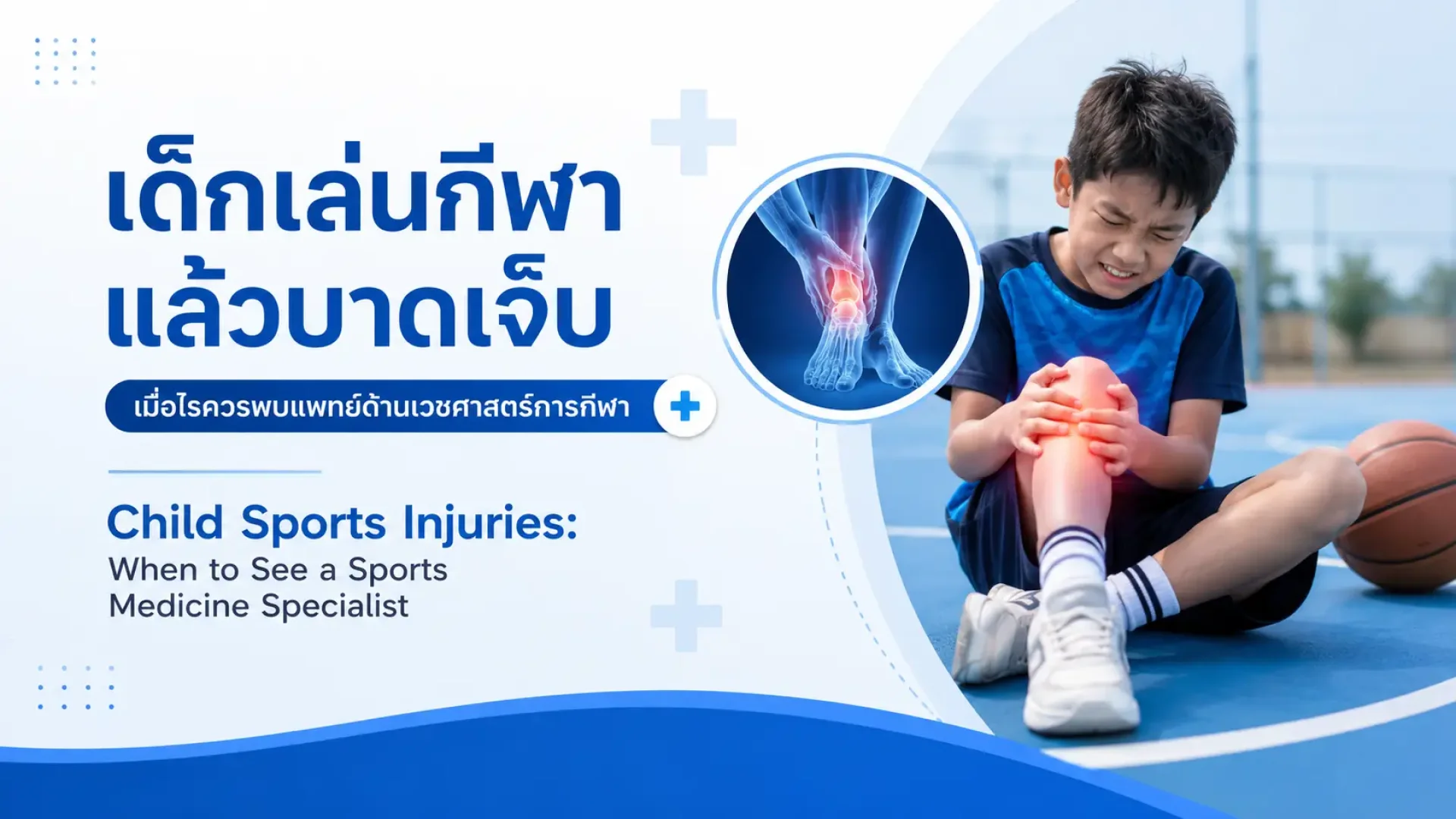
outh Sports Injuries: When to See a Sports Medicine Doctor
Children and sports go hand in hand. Kids who run, jump, swim, play football, basketball, tennis, badminton, gymnastics, or martial arts gain much more than just muscle strength. They learn discipline, confidence, socialization, sportsmanship, and goal-setting. However, youth sports also come with a risk of injury—especially in an era where many children train harder, compete faster, specialize in a single sport year-round, and follow adult-like training schedules while their bodies are still growing.
A common dilemma for parents is: "Can they just rest at home?", "Do they need an X-ray?", "When can they return to practice?", or "When should we see a Sports Medicine doctor?" Some injuries may look minor on the first day, but returning to play too soon can lead to chronic pain, joint instability, muscle weakness, or recurrent injuries.
The most important thing to remember is that children are not miniature adults. Their bones still have growth plates, and their musculoskeletal and balance systems are still developing. Evaluating a child's sports injury requires assessing the location, mechanism of injury, severity, gait, weight-bearing ability, swelling, and the goal of returning to play safely—not just asking, "Can you still tolerate the pain?"
Why Are Child Athletes More Prone to Injuries?
Youth sports injuries can broadly be divided into two categories. The first is acute injuries, such as falls, ankle sprains, knee twists, collisions, or muscle tears. The second is overuse injuries, caused by repetitive training without adequate recovery time. Examples include anterior knee pain, pain below the kneecap, heel pain, shin pain, and shoulder or elbow pain from repetitive throwing, pitching, hitting, or serving.
The American Academy of Pediatrics (AAP) notes that the youth sports culture has shifted over the past few decades. Many children are pushed into early sports specialization, intense year-round training, and playing on multiple teams simultaneously. This is associated with an increased risk of overuse injuries, overtraining, and burnout.
The concern with overuse injuries is that they rarely stem from a single, clear event. They typically start as mild pain during practice that goes away with rest. Later, the pain occurs sooner, lasts longer, persists after playing, and eventually affects daily life. If parents or coaches dismiss this as just "normal soreness," the child may push through until it becomes a chronic problem.
Warning Signs: When to Stop Playing Immediately
The simplest rule of thumb is: If an injury changes the way a child runs, walks, or plays, they should stop immediately. Do not encourage them to "play through the pain," especially younger children who cannot clearly articulate their symptoms. The body often compensates through limping, avoiding weight-bearing, favoring one arm, unequal jumping, or unusually slow movements.
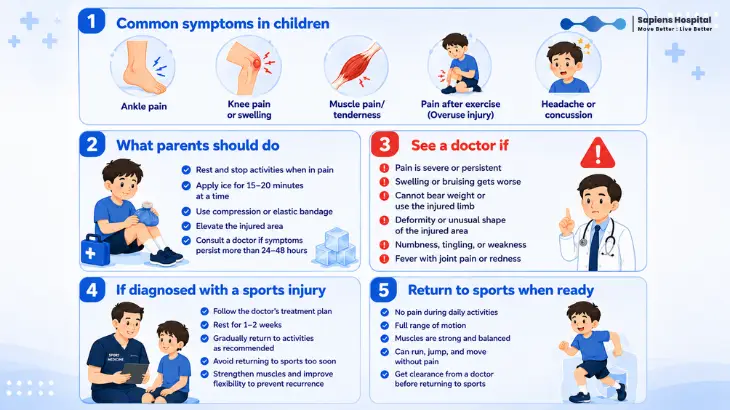
You should stop play immediately if the child experiences:
Injuries That Require Immediate Medical Attention
Youth sports injuries aren't limited to limbs. Head impacts in football, basketball, rugby, cycling, skateboarding, gymnastics, or martial arts can cause a concussion—even if the child does not lose consciousness.
Symptoms of a concussion may include headache, dizziness, nausea, blurry vision, sensitivity to light/sound, unsteadiness, decreased concentration, slowed thinking, confusion, irritability, mood changes, or sleeping more/less than usual. The CDC notes that some symptoms may not appear immediately but can develop hours or days after the injury.
If a concussion is suspected, the child must not return to play on the same day. The CDC recommends that children suspected of having a concussion be evaluated by a healthcare provider and should not return to sports, cycling, skateboarding, or risky activities until medically cleared.
Red Flags for the ER after a head impact: Loss of consciousness, seizures, repeated vomiting, worsening headache, excessive drowsiness, severe confusion, slurred speech, limb weakness, severe unsteadiness, unequal pupil size, or significant behavioral changes. These require urgent brain injury assessment.
Chronic Sports Pain: Don't Wait Until They Can't Play
Many children do not see a doctor on the day of the injury but arrive later with chronic pain, such as knee pain after practice, heel pain when kicking, shin pain when running, or shoulder/elbow pain from swimming, throwing, or racket sports.
Overuse injuries typically progress from pain after practice, to pain during practice, and eventually to pain during daily activities. At that point, simply resting is often not enough. A specialist must evaluate the underlying factors causing the recurrence, such as muscle imbalances, poor technique, excessive training loads, improper footwear/surfaces, or returning to play too quickly.
The AAOS notes that overuse injuries in children occur when repetitive activities prevent the body from recovering. Common examples include Achilles tendinitis, Osgood-Schlatter disease, jumper’s knee, Sever’s disease, shin splints, stress fractures, and throwing injuries in the elbow.
Knee Pain in Young Athletes
Knee pain is common in sports involving kicking, running, jumping, quick changes of direction, or repetitive squatting. Children may develop Osgood-Schlatter disease (pain below the knee at the tibial tubercle) or patellofemoral pain (pain around the kneecap when using stairs, sitting with bent knees, or running).
Ankle sprains are very common. Mild sprains may improve with rest, ice, compression, elevation, and gradual rehab. However, if there is severe swelling, bruising, bone tenderness, inability to walk, or prolonged pain, it must be evaluated for fractures or a "high ankle sprain" (syndesmosis injury).
Children who run or jump frequently may experience heel pain from Sever’s disease, common during growth spurts. Increasing running distance/intensity too quickly can cause shin splints or stress fractures (tiny cracks in the bone from repetitive stress).
Athletes in swimming, tennis, baseball, volleyball, or gymnastics may experience upper extremity pain. In growing children, this pain often involves the growth plates or tendon insertion sites, not just simple muscle soreness. If pain is localized, worsens with practice, decreases throwing/hitting power, reduces joint mobility, or radiates down the arm, consult a Sports Medicine doctor to evaluate biomechanics, core/scapular strength, and to plan a safe return.
How Does a Sports Medicine Specialist Differ from a General Doctor?
A Sports Medicine physician doesn't just look for broken bones. They evaluate the mechanism of injury, type of sport, competition level, training schedule, strength, flexibility, balance, movement mechanics, footwear, equipment, and readiness to return to play safely.
For example, a child may present with knee pain, but the root cause might be weak hip muscles, tight ankles, or overtraining. The treatment involves diagnosis, rehabilitation, adjusting the training load, and preventing re-injury. The goal is not just "resting until the pain is gone," but returning the athlete to their sport stronger and more resilient.
Initial Care and Return to Play
When Is It Safe to Return to Sports?
Clearance to play should not be based solely on days rested. The child must be pain-free in daily life, have nearly full range of motion, adequate muscle strength, good balance, and be able to run, jump, or perform sport-specific movements without pain or subsequent swelling.
Instead of asking, "Did you win?" or "Did you play well?", parents should ask:
"Does anything hurt today?"
"Did it hurt during or after playing?"
"Is there any part of your body that feels unstable or that you're afraid to use?"
Many young athletes hide their symptoms for fear of being benched or letting the team down. Parents and coaches must foster a culture where reporting pain is seen as a responsibility to their body, not a weakness.
Frequently Asked Questions (FAQs)
The ultimate goal of treatment isn't just pain relief; it's to safely return the child to their sport, moving better, stronger, and protected from future injuries. Because for children, sports are more than just a game—they are essential to their growth, confidence, and long-term quality of life.
If a child experiences severe pain, inability to walk, a hot/red swollen joint, limb deformity, numbness, weakness, or head trauma accompanied by drowsiness, repeated vomiting, seizures, or rapid deterioration, go to the Emergency Room immediately.
Sapiens Hospital Move Better : Live Better Tel. 02-111-3703
References:
American Academy of Pediatrics. Sports Specialization and Intensive Training in Young Athletes. Pediatrics. Reaffirmed with updates 2021.
American Academy of Orthopaedic Surgeons. Overuse Injuries in Children. OrthoInfo.
American Academy of Orthopaedic Surgeons. A Guide to Safety for Young Athletes. OrthoInfo.
Royal Children’s Hospital Melbourne. Clinical Practice Guidelines: Ankle Sprains, Emergency Department.
Centers for Disease Control and Prevention. HEADS UP: Signs and Symptoms of Concussion.
Centers for Disease Control and Prevention. HEADS UP: What to do After a Concussion.
Centers for Disease Control and Prevention. HEADS UP: Returning to Sports.
Children and sports go hand in hand. Kids who run, jump, swim, play football, basketball, tennis, badminton, gymnastics, or martial arts gain much more than just muscle strength. They learn discipline, confidence, socialization, sportsmanship, and goal-setting. However, youth sports also come with a risk of injury—especially in an era where many children train harder, compete faster, specialize in a single sport year-round, and follow adult-like training schedules while their bodies are still growing.
A common dilemma for parents is: "Can they just rest at home?", "Do they need an X-ray?", "When can they return to practice?", or "When should we see a Sports Medicine doctor?" Some injuries may look minor on the first day, but returning to play too soon can lead to chronic pain, joint instability, muscle weakness, or recurrent injuries.
The most important thing to remember is that children are not miniature adults. Their bones still have growth plates, and their musculoskeletal and balance systems are still developing. Evaluating a child's sports injury requires assessing the location, mechanism of injury, severity, gait, weight-bearing ability, swelling, and the goal of returning to play safely—not just asking, "Can you still tolerate the pain?"
Why Are Child Athletes More Prone to Injuries?
Youth sports injuries can broadly be divided into two categories. The first is acute injuries, such as falls, ankle sprains, knee twists, collisions, or muscle tears. The second is overuse injuries, caused by repetitive training without adequate recovery time. Examples include anterior knee pain, pain below the kneecap, heel pain, shin pain, and shoulder or elbow pain from repetitive throwing, pitching, hitting, or serving.
The American Academy of Pediatrics (AAP) notes that the youth sports culture has shifted over the past few decades. Many children are pushed into early sports specialization, intense year-round training, and playing on multiple teams simultaneously. This is associated with an increased risk of overuse injuries, overtraining, and burnout.
The concern with overuse injuries is that they rarely stem from a single, clear event. They typically start as mild pain during practice that goes away with rest. Later, the pain occurs sooner, lasts longer, persists after playing, and eventually affects daily life. If parents or coaches dismiss this as just "normal soreness," the child may push through until it becomes a chronic problem.
Warning Signs: When to Stop Playing Immediately
The simplest rule of thumb is: If an injury changes the way a child runs, walks, or plays, they should stop immediately. Do not encourage them to "play through the pain," especially younger children who cannot clearly articulate their symptoms. The body often compensates through limping, avoiding weight-bearing, favoring one arm, unequal jumping, or unusually slow movements.
You should stop play immediately if the child experiences:
- Rapid joint swelling after the injury
- Severe pain that prevents weight-bearing
- A feeling of looseness or instability in the knee or ankle
- A "pop" sound at the time of injury
- Visible limb deformity
- Point tenderness directly on a bone
- Numbness, weakness, or cold hands/feet
- Skin color changes, or pain that doesn't subside with rest
Injuries That Require Immediate Medical Attention
- Inability to bear weight: If a child cannot walk or refuses to put weight on the injured limb, see a doctor immediately. Do not wait for several days, as some fractures in children do not show obvious deformities, and growth plate injuries may require clinical and radiographic evaluation.
- Severe swelling: Rapid, significant swelling, especially with extensive bruising, requires examination. This could indicate bleeding in the joint, ligament tears, meniscus injuries, or fractures.
- Signs of Infection: Swelling accompanied by redness, heat, fever, or severe pain without a clear accident mechanism requires immediate attention to rule out bone or joint infections.
- Nerve or Vascular Issues: If the child experiences numbness, weakness, cold hands/feet, pale or bluish skin, inability to move fingers/toes, or unusually severe pain after a cast or bandage is applied, seek urgent care. RCH Melbourne recommends seeing a doctor if these symptoms do not improve with recommended pain medication.
Youth sports injuries aren't limited to limbs. Head impacts in football, basketball, rugby, cycling, skateboarding, gymnastics, or martial arts can cause a concussion—even if the child does not lose consciousness.
Symptoms of a concussion may include headache, dizziness, nausea, blurry vision, sensitivity to light/sound, unsteadiness, decreased concentration, slowed thinking, confusion, irritability, mood changes, or sleeping more/less than usual. The CDC notes that some symptoms may not appear immediately but can develop hours or days after the injury.
If a concussion is suspected, the child must not return to play on the same day. The CDC recommends that children suspected of having a concussion be evaluated by a healthcare provider and should not return to sports, cycling, skateboarding, or risky activities until medically cleared.
Red Flags for the ER after a head impact: Loss of consciousness, seizures, repeated vomiting, worsening headache, excessive drowsiness, severe confusion, slurred speech, limb weakness, severe unsteadiness, unequal pupil size, or significant behavioral changes. These require urgent brain injury assessment.
Chronic Sports Pain: Don't Wait Until They Can't Play
Many children do not see a doctor on the day of the injury but arrive later with chronic pain, such as knee pain after practice, heel pain when kicking, shin pain when running, or shoulder/elbow pain from swimming, throwing, or racket sports.
Overuse injuries typically progress from pain after practice, to pain during practice, and eventually to pain during daily activities. At that point, simply resting is often not enough. A specialist must evaluate the underlying factors causing the recurrence, such as muscle imbalances, poor technique, excessive training loads, improper footwear/surfaces, or returning to play too quickly.
The AAOS notes that overuse injuries in children occur when repetitive activities prevent the body from recovering. Common examples include Achilles tendinitis, Osgood-Schlatter disease, jumper’s knee, Sever’s disease, shin splints, stress fractures, and throwing injuries in the elbow.
Knee Pain in Young Athletes
Knee pain is common in sports involving kicking, running, jumping, quick changes of direction, or repetitive squatting. Children may develop Osgood-Schlatter disease (pain below the knee at the tibial tubercle) or patellofemoral pain (pain around the kneecap when using stairs, sitting with bent knees, or running).
- If the knee swells rapidly after twisting, pops, cannot bear weight, feels loose, or is locked, see a doctor. This could indicate an ACL tear, meniscus tear, cartilage damage, or fracture. Resting for 2–3 days and returning to a game with a swollen knee can worsen the injury and delay recovery.
Ankle sprains are very common. Mild sprains may improve with rest, ice, compression, elevation, and gradual rehab. However, if there is severe swelling, bruising, bone tenderness, inability to walk, or prolonged pain, it must be evaluated for fractures or a "high ankle sprain" (syndesmosis injury).
- RCH Melbourne recommends the RICER protocol (Rest, Ice, Compression, Elevation, Referral) and emphasizes that rehabilitation to improve proprioception, balance, and muscular control is crucial to prevent recurrent sprains.
- "No pain" does not equal "Ready to compete." Returning to play with poor single-leg balance or fear of changing directions significantly increases the risk of re-injury.
Children who run or jump frequently may experience heel pain from Sever’s disease, common during growth spurts. Increasing running distance/intensity too quickly can cause shin splints or stress fractures (tiny cracks in the bone from repetitive stress).
- Warning signs: Point tenderness on the bone, pain that increases with activity, pain at rest/night, or limping. Stop high-impact activities and consult a doctor immediately to prevent the damage from worsening.
Athletes in swimming, tennis, baseball, volleyball, or gymnastics may experience upper extremity pain. In growing children, this pain often involves the growth plates or tendon insertion sites, not just simple muscle soreness. If pain is localized, worsens with practice, decreases throwing/hitting power, reduces joint mobility, or radiates down the arm, consult a Sports Medicine doctor to evaluate biomechanics, core/scapular strength, and to plan a safe return.
How Does a Sports Medicine Specialist Differ from a General Doctor?
A Sports Medicine physician doesn't just look for broken bones. They evaluate the mechanism of injury, type of sport, competition level, training schedule, strength, flexibility, balance, movement mechanics, footwear, equipment, and readiness to return to play safely.
For example, a child may present with knee pain, but the root cause might be weak hip muscles, tight ankles, or overtraining. The treatment involves diagnosis, rehabilitation, adjusting the training load, and preventing re-injury. The goal is not just "resting until the pain is gone," but returning the athlete to their sport stronger and more resilient.
Initial Care and Return to Play
- Initial Care (First 24–48 Hours)
- Stop the painful activity.
- Apply ice intermittently.
- Elevate the injured area above the heart if possible.
- Apply a firm (but not overly tight) compression bandage.
- Administer age- and weight-appropriate pain relief.
- Do NOT massage aggressively, twist, or attempt to "pop" or "adjust" the joints yourself.
When Is It Safe to Return to Sports?
Clearance to play should not be based solely on days rested. The child must be pain-free in daily life, have nearly full range of motion, adequate muscle strength, good balance, and be able to run, jump, or perform sport-specific movements without pain or subsequent swelling.
- For concussions, the CDC recommends a strict 6-step return-to-play progression under the guidance of a healthcare provider.
- For joint/muscle injuries, returning too early is the leading cause of re-injury. The AAOS advises getting medical clearance before returning to sports, even if the child "feels better."
- Balance Training & Rest: Avoid single-sport specialization year-round. The AAOS recommends limiting the number of teams a child plays on in one season to allow for recovery and reduce overuse injuries.
- Warm-up & Cool-down: These are mandatory, alongside age-appropriate strength, balance, flexibility, and neuromuscular training.
- Nutrition & Sleep: Adequate sleep, hydration, and nutrition are primary injury prevention tools.
- Proper Equipment: Shoes should fit and not be overly worn. Ensure safe playing surfaces and teach proper techniques (e.g., landing, cutting, throwing, and falling safely).
Instead of asking, "Did you win?" or "Did you play well?", parents should ask:
"Does anything hurt today?"
"Did it hurt during or after playing?"
"Is there any part of your body that feels unstable or that you're afraid to use?"
Many young athletes hide their symptoms for fear of being benched or letting the team down. Parents and coaches must foster a culture where reporting pain is seen as a responsibility to their body, not a weakness.
Frequently Asked Questions (FAQs)
- My child sprained their ankle but can still walk. Do they need an X-ray?
Not always. However, if there is bone tenderness in specific areas, or if they cannot bear weight or walk four steps during evaluation, a doctor should assess if an X-ray is needed based on clinical guidelines. - They have pain after every practice, but it goes away with rest. Should we see a doctor?
Yes. If the pain is recurrent, starts happening sooner, requires pain medication to practice, or begins affecting daily life, you should see a Sports Medicine doctor. This is likely an overuse injury that requires load adjustment and rehab. Don't wait until they can't play at all. - They hit their head but didn't pass out. Can they keep playing?
No. If a concussion is suspected, the child must be removed from play and evaluated. Concussions do not require a loss of consciousness, and symptoms can appear later. The CDC advises against returning to play on the same day. - Should I use ice or heat for an injury?
For acute injuries (first 24-48 hours) with pain, swelling, or bruising, use ice. Heat is generally used later for chronic muscle tightness or stiffness. If unsure, or if swelling/pain is severe, consult a doctor first.
The ultimate goal of treatment isn't just pain relief; it's to safely return the child to their sport, moving better, stronger, and protected from future injuries. Because for children, sports are more than just a game—they are essential to their growth, confidence, and long-term quality of life.
If a child experiences severe pain, inability to walk, a hot/red swollen joint, limb deformity, numbness, weakness, or head trauma accompanied by drowsiness, repeated vomiting, seizures, or rapid deterioration, go to the Emergency Room immediately.
Sapiens Hospital Move Better : Live Better Tel. 02-111-3703
References:
American Academy of Pediatrics. Sports Specialization and Intensive Training in Young Athletes. Pediatrics. Reaffirmed with updates 2021.
American Academy of Orthopaedic Surgeons. Overuse Injuries in Children. OrthoInfo.
American Academy of Orthopaedic Surgeons. A Guide to Safety for Young Athletes. OrthoInfo.
Royal Children’s Hospital Melbourne. Clinical Practice Guidelines: Ankle Sprains, Emergency Department.
Centers for Disease Control and Prevention. HEADS UP: Signs and Symptoms of Concussion.
Centers for Disease Control and Prevention. HEADS UP: What to do After a Concussion.
Centers for Disease Control and Prevention. HEADS UP: Returning to Sports.
Related Content

When should a child with a high fever see a doctor? Learn the emergency red flags, dehydration signs, and febrile seizure care from SapienS Hospital.
10 Jul 2026

Is your child's leg or knee pain just a normal part of growing up, or is it a hidden sports injury?
Learn how to spot the crucial differences, identify medical red flags, and know exactly when to consult a doctor.
10 Jul 2026
If your child has a poor appetite, drops below weight and height standards, looks pale, gets sick frequently, or has chronic bowel issues—including difficulty swallowing, choking, vomiting, or persistent stomach pain—you should take them to see a doctor immediately.
10 Jul 2026
