Abscesses, Pus, and Infected Wounds: When Is Drainage Necessary?
Last updated: 1 Aug 2026
Abscesses and Infected Wounds: When Is Drainage Necessary?
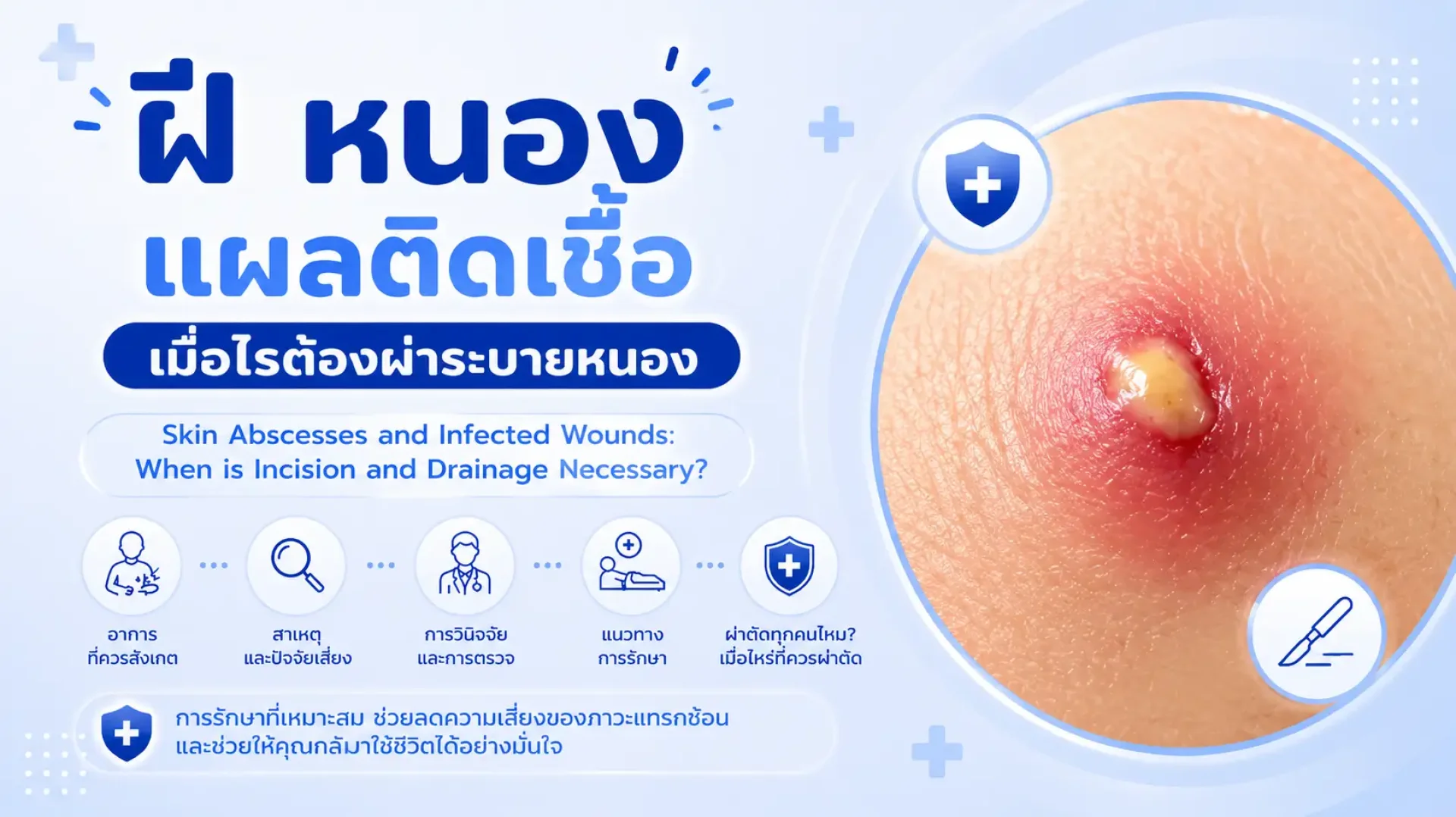
A small boil isn't always just a small issue.
Many people notice a small red bump under their skin and initially mistake it for a pimple, an insect bite, or a minor scrape. However, within a few days, the lump may become swollen, red, hot, and increasingly painful. Sometimes, it throbs as if something is trapped inside. In some cases, a pus head appears, accompanied by oozing fluid, a foul odor, or even a fever.
This might not be just a simple inflamed wound; it could be an "abscess"—an infected wound with a pocket of pus trapped beneath the skin.
A common misconception is that simply taking antibiotics is enough to treat an infected or pus-filled wound. Medically, however, if there is a pocket of pus beneath the skin, medication alone is rarely the primary solution. Antibiotics have limited ability to penetrate and eliminate a contained pocket of pus. Therefore, draining the pus is the cornerstone of treatment in many cases. Simply put: "If there is a trapped pocket of pus, it must be properly drained." You should not leave your body to fight the pathogens inside the cavity on its own.
This article will explain what an abscess is, which types of infected wounds require drainage, when you should urgently see a doctor, and why you should never squeeze or lance an abscess at home.
What is an Abscess?
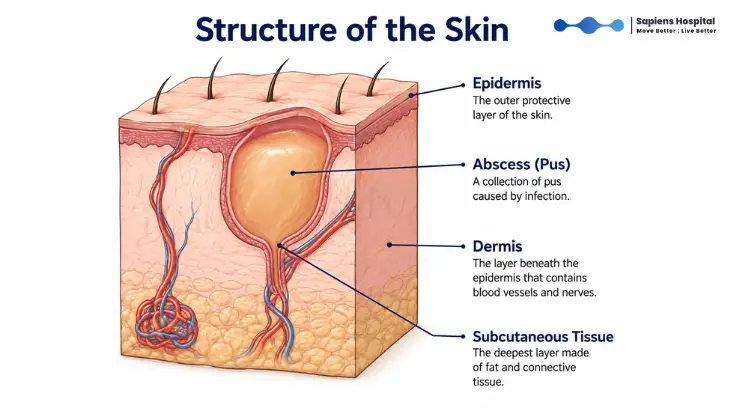
An abscess is an infection that causes a pocket of pus to form within the tissue. Pus consists of bacteria, white blood cells, dead tissue cells, and inflammatory fluids. Abscesses can occur almost anywhere on the body, including:
How Does an Abscess Differ from Normal Inflammation?
An inflamed wound or a superficial skin infection may appear red, hot, swollen, and painful, but it doesn't yet have a distinct pocket of pus. This condition is often referred to as cellulitis (inflammation of the skin and underlying tissues). However, once pus begins to pool, the characteristics change:
Why Does Pus Need to be Drained?
Pus trapped beneath the skin is like an isolated chamber of infection. If it is not drained, the pressure inside the cavity increases, causing more pain, destroying surrounding tissue, and potentially allowing the infection to spread to nearby areas.
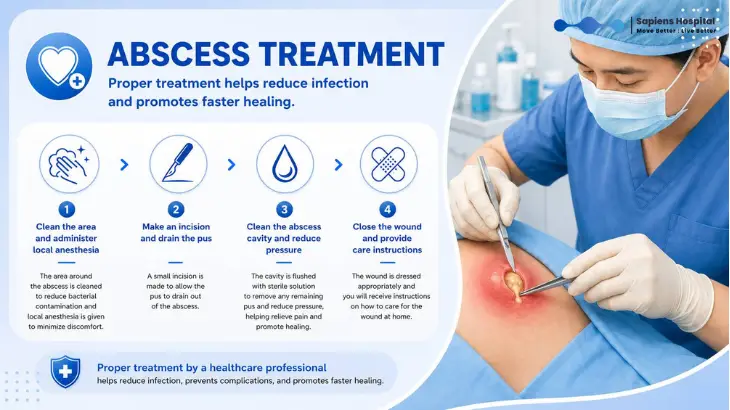
Incision and Drainage (I&D) is a medical procedure used to open a pathway for the pus to exit the cavity, reducing pressure, clearing out the bacteria, and allowing the wound to begin healing.
Antibiotics are helpful in certain cases, but if there is a clear pocket of pus, medication alone may not be enough. Think of it like a room flooded with dirty water; pouring in disinfectant might help a little, but the problem won't be solved until the dirty water is drained out.
Which Wounds Require Drainage?
You should consult a doctor to evaluate for drainage if you experience any of the following:
Certain groups are at a higher risk of severe infections or delayed healing and should not wait to see if symptoms improve on their own:
Not every red wound requires an incision. If it is an early-stage skin infection without a pus pocket, no pus head, and a doctor's examination confirms no trapped pus, it can often be treated with proper wound cleaning, appropriate antibiotics, and close monitoring.
Minor inflammations, like infected hair follicles or small bumps, may improve with warm compresses, good hygiene, and observation. However, do not squeeze, pick, or use a needle to pierce it yourself. If the symptoms do not improve within 24–48 hours, or if redness spreads, pain worsens, or pus forms, seek medical attention.
How is the Drainage Procedure Performed?
Incision and drainage is generally a minor procedure, but it must be done using sterile techniques and with a proper evaluation of the site. Typically, a doctor will:
Does Everyone Need Antibiotics?
Not always. For small, uncomplicated abscesses in healthy individuals with no fever, no spreading redness, and proper drainage, antibiotics may not be necessary. However, antibiotics are typically prescribed if:
Why You Shouldn't Pop, Squeeze, or Lance an Abscess Yourself
Many try to squeeze the pus out, thinking it will speed up healing, but doing so carries significant risks:
How Dangerous Are Abscesses and Pus?
Small abscesses treated promptly and correctly usually heal well. However, if left untreated or managed poorly, complications can arise, including:
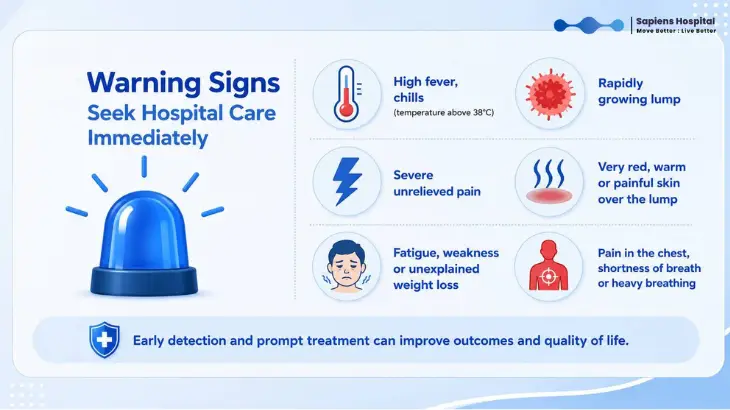
Go to the hospital immediately if you experience:
After drainage, the wound needs continuous care because the abscess cavity must heal from the inside out. If the skin closes too quickly while empty space remains inside, the abscess can reform.
General Care Guidelines:
How to Prevent Abscesses and Skin Infections
Prevention involves reducing the chance of bacteria entering the skin and managing underlying conditions.
Frequently Asked Questions (FAQ)
Abscesses and infected wounds are common but should never be ignored—especially when pus is trapped beneath the skin. The primary treatment in many cases is proper medical drainage, not just taking antibiotics. If a wound becomes increasingly swollen, red, hot, or painful, develops a soft center, oozes pus, or is accompanied by a fever, consult a doctor immediately. Never squeeze or lance it yourself, as this can worsen the infection. Early treatment leads to the best outcomes, so seeking medical attention at the first sign of abnormality is always the safest choice.
For Inquiries and Appointments:
Sapiens Hospital – Move Better : Live Better
Tel. 02-111-3703
Academic References:
Stevens DL, Bisno AL, Chambers HF, et al. Practice Guidelines for the Diagnosis and Management of Skin and Soft Tissue Infections: 2014 Update by the Infectious Diseases Society of America. Clinical Infectious Diseases. 2014;59(2):e10–e52.
National Institute for Health and Care Excellence. Cellulitis and erysipelas: antimicrobial prescribing. NICE Guideline NG141. 2019.
Vermandere M, Aertgeerts B, Agoritsas T, et al. Antibiotics after incision and drainage for uncomplicated skin abscesses: a clinical practice guideline. BMJ. 2018;360:k243.
Ramakrishnan K, Salinas RC, Agudelo Higuita NI. Skin and Soft Tissue Infections. American Family Physician. 2015;92(6):474–483.
Wang W, Chen W, Liu Y, et al. Antibiotics for uncomplicated skin abscesses: systematic review and network meta-analysis. BMJ Open. 2018;8:e020991.
Pastorino A, Tavarez MM. Incision and Drainage. StatPearls Publishing. Updated 2023.
Raff AB, Kroshinsky D. Cellulitis: A Review. JAMA. 2016;316(3):325–337.
A small boil isn't always just a small issue.
Many people notice a small red bump under their skin and initially mistake it for a pimple, an insect bite, or a minor scrape. However, within a few days, the lump may become swollen, red, hot, and increasingly painful. Sometimes, it throbs as if something is trapped inside. In some cases, a pus head appears, accompanied by oozing fluid, a foul odor, or even a fever.
This might not be just a simple inflamed wound; it could be an "abscess"—an infected wound with a pocket of pus trapped beneath the skin.
A common misconception is that simply taking antibiotics is enough to treat an infected or pus-filled wound. Medically, however, if there is a pocket of pus beneath the skin, medication alone is rarely the primary solution. Antibiotics have limited ability to penetrate and eliminate a contained pocket of pus. Therefore, draining the pus is the cornerstone of treatment in many cases. Simply put: "If there is a trapped pocket of pus, it must be properly drained." You should not leave your body to fight the pathogens inside the cavity on its own.
This article will explain what an abscess is, which types of infected wounds require drainage, when you should urgently see a doctor, and why you should never squeeze or lance an abscess at home.
What is an Abscess?
An abscess is an infection that causes a pocket of pus to form within the tissue. Pus consists of bacteria, white blood cells, dead tissue cells, and inflammatory fluids. Abscesses can occur almost anywhere on the body, including:
- Face
- Armpits
- Back
- Buttocks
- Groin
- Perianal area (around the anus)
- Breasts
- Hands and fingers
- Surgical incision sites
- Areas with pre-existing cysts or subcutaneous lumps
How Does an Abscess Differ from Normal Inflammation?
An inflamed wound or a superficial skin infection may appear red, hot, swollen, and painful, but it doesn't yet have a distinct pocket of pus. This condition is often referred to as cellulitis (inflammation of the skin and underlying tissues). However, once pus begins to pool, the characteristics change:
- A localized swollen lump appears.
- Pain intensifies.
- Deep tenderness when pressed.
- The skin becomes tight or shiny.
- The center may feel soft, indicating fluid inside.
- A visible pus head forms, or pus starts to drain.
- Fever or fatigue may occur.
Why Does Pus Need to be Drained?
Pus trapped beneath the skin is like an isolated chamber of infection. If it is not drained, the pressure inside the cavity increases, causing more pain, destroying surrounding tissue, and potentially allowing the infection to spread to nearby areas.
Incision and Drainage (I&D) is a medical procedure used to open a pathway for the pus to exit the cavity, reducing pressure, clearing out the bacteria, and allowing the wound to begin healing.
Antibiotics are helpful in certain cases, but if there is a clear pocket of pus, medication alone may not be enough. Think of it like a room flooded with dirty water; pouring in disinfectant might help a little, but the problem won't be solved until the dirty water is drained out.
Which Wounds Require Drainage?
You should consult a doctor to evaluate for drainage if you experience any of the following:
- A swollen, red, hot, and increasingly painful lump: If the inflammation becomes progressively more painful—especially with a throbbing or deep pain—it often indicates trapped pus.
- Soft or fluid-like feeling when pressed: This condition, known as fluctuation, is a strong indicator of a subcutaneous pus pocket that usually requires drainage.
- Visible pus head or oozing: Even if pus starts to drain on its own, it doesn't mean it will all come out. Often, the opening is too small, leaving residual pus inside and causing recurrences.
- The wound enlarges or redness spreads: If the redness expands, swelling increases, or pain worsens, the infection may be spreading. A doctor must evaluate if there is both an abscess and cellulitis.
- Fever, chills, or severe fatigue: These symptoms indicate a systemic response to the infection. Drainage, likely combined with antibiotics, is necessary.
- Abscesses in high-risk areas: Infections on the face, around the eyes, hands, fingers, genitals, breasts, perianal area, or near joints need prompt medical evaluation, as the infection can spread quickly or damage nearby crucial structures.
Certain groups are at a higher risk of severe infections or delayed healing and should not wait to see if symptoms improve on their own:
- Diabetic patients
- Immunocompromised individuals
- The elderly
- Patients with kidney or liver disease
- Those taking immunosuppressants or steroids
- Cancer patients or those undergoing chemotherapy
- Individuals with chronic wounds or peripheral artery disease
Not every red wound requires an incision. If it is an early-stage skin infection without a pus pocket, no pus head, and a doctor's examination confirms no trapped pus, it can often be treated with proper wound cleaning, appropriate antibiotics, and close monitoring.
Minor inflammations, like infected hair follicles or small bumps, may improve with warm compresses, good hygiene, and observation. However, do not squeeze, pick, or use a needle to pierce it yourself. If the symptoms do not improve within 24–48 hours, or if redness spreads, pain worsens, or pus forms, seek medical attention.
How is the Drainage Procedure Performed?
Incision and drainage is generally a minor procedure, but it must be done using sterile techniques and with a proper evaluation of the site. Typically, a doctor will:
- Examine the location, size, and depth of the abscess.
- Clean and sterilize the skin.
- Inject a local anesthetic.
- Make a small incision in the appropriate area.
- Drain the pus.
- Irrigate (wash out) the cavity if necessary.
- Collect a pus sample for culture in some cases.
- Pack the wound with gauze or a drainage material if needed.
- Bandage the wound and schedule follow-up care.
Does Everyone Need Antibiotics?
Not always. For small, uncomplicated abscesses in healthy individuals with no fever, no spreading redness, and proper drainage, antibiotics may not be necessary. However, antibiotics are typically prescribed if:
- There is fever, chills, or systemic symptoms.
- Redness spreads significantly around the wound.
- Cellulitis is present.
- There are multiple abscesses or a very large abscess.
- The abscess is in a high-risk area (face, hands, perianal, genitals).
- The patient has diabetes, a weak immune system, is elderly, or has multiple underlying conditions.
- The patient has a prosthetic heart valve or specific medical risks.
- There is suspicion of drug-resistant bacteria (e.g., MRSA).
Why You Shouldn't Pop, Squeeze, or Lance an Abscess Yourself
Many try to squeeze the pus out, thinking it will speed up healing, but doing so carries significant risks:
- Incomplete drainage: Leaves pus inside, leading to recurrence.
- Deeper infection: Squeezing can push the bacteria deeper into the tissues.
- Enlarged wound & worse scarring.
- Secondary infection: From using unsterilized tools.
- Bleeding or structural damage: Risk of hitting nerves, blood vessels, or vital structures.
- Complicates future treatment.
How Dangerous Are Abscesses and Pus?
Small abscesses treated promptly and correctly usually heal well. However, if left untreated or managed poorly, complications can arise, including:
- Infection spreading through the skin and subcutaneous tissue.
- Deep tissue abscesses.
- Chronic wounds.
- Bloodstream infections (sepsis).
- Bone infections (osteomyelitis), especially in deep foot wounds or diabetic patients.
- Tissue death (necrosis).
- Severe infections like necrotizing fasciitis (flesh-eating disease), which is rare but a medical emergency.
Go to the hospital immediately if you experience:
- High fever or chills.
- Unusually severe pain, or pain that feels disproportionate to the wound's appearance.
- Rapidly spreading redness.
- Skin turning purple or black, or the formation of blood blisters.
- A very foul odor coming from the wound.
- A large amount of pus.
- Lethargy, extreme fatigue, or dizziness.
- Rapid heartbeat or fast breathing.
- Severe nausea or vomiting.
- An infected wound in a diabetic or immunocompromised patient.
- Specific red-flag locations: Foot wounds in diabetics; wounds near the eyes, hands, fingers, genitals, or perianal area; severe pain when moving fingers, toes, or joints.
After drainage, the wound needs continuous care because the abscess cavity must heal from the inside out. If the skin closes too quickly while empty space remains inside, the abscess can reform.
General Care Guidelines:
- Clean and dress the wound as instructed by your doctor.
- Keep the wound clean and dry for the specified duration.
- Do not remove packing gauze or drainage materials yourself unless instructed by a doctor.
- Take all prescribed medications completely.
- Wash hands before and after touching the wound.
- Avoid squeezing or pressing the wound.
- Watch for signs of increased redness, swelling, pain, or returning pus.
- Attend all follow-up appointments to ensure the cavity is closing properly.
How to Prevent Abscesses and Skin Infections
Prevention involves reducing the chance of bacteria entering the skin and managing underlying conditions.
- Maintain good skin hygiene.
- Wash minor scrapes immediately with clean water or saline.
- Cover wounds in areas prone to friction or dirt.
- Do not pick, scratch, or squeeze pimples and inflamed bumps.
- Do not share sharp personal items, like razors.
- Treat fungal foot infections (athlete's foot) and cracked skin.
- Keep blood sugar levels well-controlled if you have diabetes.
- Manage constipation and avoid excessive sweating/moisture in areas prone to recurring abscesses.
- Change clothes and towels regularly.
Frequently Asked Questions (FAQ)
- Can I just take medication if there is pus?
- Can I use a warm compress on a small abscess?
- Does draining an abscess hurt?
- Will I need stitches after the drainage?
- Why do I keep getting abscesses?
- Is foul-smelling pus dangerous?
Abscesses and infected wounds are common but should never be ignored—especially when pus is trapped beneath the skin. The primary treatment in many cases is proper medical drainage, not just taking antibiotics. If a wound becomes increasingly swollen, red, hot, or painful, develops a soft center, oozes pus, or is accompanied by a fever, consult a doctor immediately. Never squeeze or lance it yourself, as this can worsen the infection. Early treatment leads to the best outcomes, so seeking medical attention at the first sign of abnormality is always the safest choice.
For Inquiries and Appointments:
Sapiens Hospital – Move Better : Live Better
Tel. 02-111-3703
Academic References:
Stevens DL, Bisno AL, Chambers HF, et al. Practice Guidelines for the Diagnosis and Management of Skin and Soft Tissue Infections: 2014 Update by the Infectious Diseases Society of America. Clinical Infectious Diseases. 2014;59(2):e10–e52.
National Institute for Health and Care Excellence. Cellulitis and erysipelas: antimicrobial prescribing. NICE Guideline NG141. 2019.
Vermandere M, Aertgeerts B, Agoritsas T, et al. Antibiotics after incision and drainage for uncomplicated skin abscesses: a clinical practice guideline. BMJ. 2018;360:k243.
Ramakrishnan K, Salinas RC, Agudelo Higuita NI. Skin and Soft Tissue Infections. American Family Physician. 2015;92(6):474–483.
Wang W, Chen W, Liu Y, et al. Antibiotics for uncomplicated skin abscesses: systematic review and network meta-analysis. BMJ Open. 2018;8:e020991.
Pastorino A, Tavarez MM. Incision and Drainage. StatPearls Publishing. Updated 2023.
Raff AB, Kroshinsky D. Cellulitis: A Review. JAMA. 2016;316(3):325–337.
Related Content

Experiencing lower right abdominal pain? Discover the early warning signs of appendicitis and know exactly when to seek immediate medical attention. Read our comprehensive health guide from Sapiens Hospital to ensure you get the right diagnosis and expert care before complications arise.
9 Jul 2026


Surgery can be a source of anxiety for many, even when doctors assure you it is a minor procedure. Some fear the pain, others are anxious about anesthesia, while some worry about their underlying conditions or the risk of infection.
9 Jul 2026
