What is Day Surgery? Same-Day Discharge & Fast Recovery
Last updated: 1 Aug 2026

What is Day Surgery? Can I really go home the same day? | Sapiens Hospital
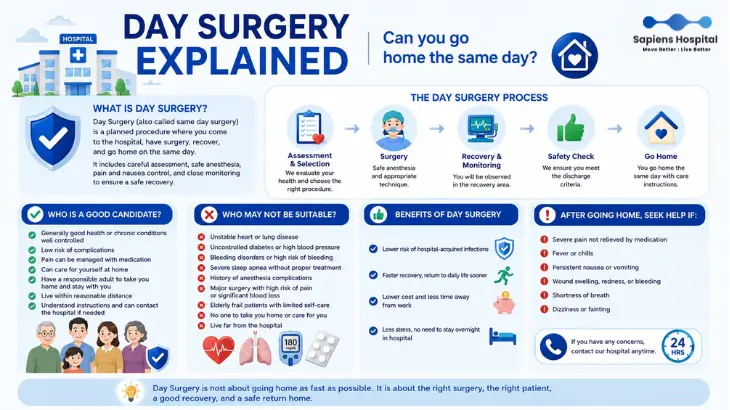
Day Surgery, or same-day surgery, is a planned medical procedure that allows patients to undergo surgery and return home safely on the exact same day. This pathway requires a comprehensive pre-operative assessment, effective pain and nausea management, and rigorous post-operative monitoring to ensure absolute patient safety.
When hearing the word "surgery," many people immediately think of prolonged hospital stays, extended fasting, large incisions, long recovery periods, and a generally overwhelming experience.
Today, however, surgical approaches have evolved significantly. With minimally invasive techniques, safer and shorter-acting anesthetics, advanced pain management protocols, and standardized perioperative care, a highly effective treatment pathway has emerged: "Day Surgery."
While many are intrigued by this concept, it naturally brings up several questions:
What is Day Surgery?
"Day Surgery" (also known as same-day surgery or ambulatory surgery) is a surgical or procedural pathway designed for patients to be admitted, undergo their procedure, recover, and be discharged home safely all within the same day, without the need for an overnight hospital stay.
The operative phrase here is "planned from the start." Day Surgery is not about rushing patients out the door without observation. Rather, it is a comprehensive system of care that begins well before the operation. This includes patient selection, evaluating underlying health conditions, selecting the optimal anesthesia method, planning pain management, preventing post-operative nausea, and establishing strict clinical criteria for a safe discharge.
Therefore, a successful Day Surgery program doesn't mean "the fastest surgery," but rather "the most appropriate surgery with optimal recovery and a safe discharge."
How does Day Surgery differ from Minor Surgery?
Many people assume that Day Surgery only refers to minor procedures, but the two are not entirely synonymous.
"Minor surgery" typically refers to small-scale procedures—such as excising a cyst, removing a subcutaneous lump, suturing a wound, or draining an abscess. These are often performed under local anesthesia and take very little time.
"Day Surgery," however, is a much broader concept. It can encompass more complex surgeries requiring regional blocks or general anesthesia, provided the patient is carefully selected and a robust, safe post-operative care system is in place.
Examples of procedures suitable for Day Surgery (in eligible patients):
Can I really go home the same day?
The answer is "Yes, for suitable patients who successfully meet our post-operative safety criteria."
Following the procedure, patients are closely monitored in the recovery room to ensure they meet the following discharge criteria:
Who is an ideal candidate for Day Surgery?
Patients suitable for Day Surgery generally meet the following profiles:
Who might NOT be suitable for Day Surgery?
Doctors may recommend an overnight stay or a longer observation period for patients in the following categories:
Fasting from food and water reduces the risk of aspiration while under anesthesia. Your medical and anesthesia team will provide explicit instructions on when to stop consuming solid foods, milk, and clear liquids. Do not sneak food or drinks if you feel hungry, as this will result in your surgery being postponed for your own safety.
3. Arrange for a caregiver and transportation:
If you receive sedatives, regional anesthesia, or general anesthesia, you must not drive yourself home. A reliable adult must accompany you. Following anesthesia, you should also avoid driving, consuming alcohol, signing legal documents, or making major decisions for the timeframe advised by your doctor.
4. Prepare your home for recovery:
Ensure your home is clean, easy to navigate, and stocked with easy-to-digest foods. Have your prescribed medications ready, arrange for someone to help care for you, and keep the hospital's contact information easily accessible.
5. Ask questions until you are confident:
Before your surgery, ensure you know:
Your medical and nursing team will assess your readiness for discharge based on strict clinical criteria, including:
How do I care for myself at home?
Going home the same day does not mean you are instantly fully healed. You must strictly adhere to post-operative instructions:
Please contact the hospital or return to see a doctor immediately if you experience any of the following:
The Advantages of Day Surgery
When applied to the right patients and procedures, Day Surgery offers numerous benefits:
While highly beneficial, Day Surgery requires specific conditions to be successful:
What kind of hospital is equipped for Day Surgery?
A hospital providing Day Surgery must be equipped with a comprehensive infrastructure, including:
Frequently Asked Questions (FAQs)
What is Day Surgery?
Day Surgery is a planned clinical pathway where a patient is admitted, undergoes a surgical procedure, recovers, and is safely discharged all within the same day, backed by rigorous pre-and post-operative safety assessments.
Is Day Surgery safe?
Yes, it is highly safe for suitable patients and procedures, provided the hospital utilizes standard protocols for patient selection, pre-operative assessment, anesthesia management, pain control, and strict discharge criteria.
Does Day Surgery require general anesthesia?
Not always. Depending on the procedure and the doctor's assessment, it may be performed under local anesthesia, regional anesthesia (nerve blocks), or general anesthesia.
Can I drive myself home after the surgery?
Generally, no. If you have received sedatives, regional anesthesia, or general anesthesia, you must not drive yourself home. A relative or caregiver must accompany you, and you should avoid driving for the duration recommended by your doctor.
What if I have severe pain after I go home?
You should take the prescribed pain medication as directed. If the pain progressively worsens, is unresponsive to medication, or is accompanied by bleeding, severe swelling, redness, or fever, you should contact the hospital or return to see a doctor immediately.
Do I need someone to stay with me at home?
Yes, you should have a reliable caregiver to take you home and stay with you, particularly during the first night post-surgery, to monitor your condition and assist you if needed.
If the doctor tells me I need to be admitted after my Day Surgery, does that mean something went wrong?
Not necessarily. Sometimes doctors require an overnight stay as a safety precaution—for example, if you are experiencing excessive pain, severe nausea, or if your vital signs have not met the strict discharge criteria. In these cases, admission is the safest and most appropriate medical decision, not a failure of the procedure.
Day Surgery is an advanced clinical pathway that allows patients to undergo surgery and recover in the comfort of their own homes on the very same day. However, it is not a rushed or simplified process. On the contrary, it demands excellent pre-operative planning, appropriate procedure selection, expert anesthesia care, meticulous pain management, strict discharge evaluations, and crystal-clear post-operative education.
While many patients can safely go home the same day, others may benefit from brief observation, and some are better suited for an inpatient stay. Therefore, the best question to ask your medical team is not simply, "Can I go home today?" but rather, "Given my specific condition, which surgical and recovery pathway is the safest and most effective for me?"
Because the ultimate goal of surgery is not just to get it done quickly, but to perform it safely, ensure a smooth recovery, and help you return to your life with confidence.
For more information or to schedule an appointment:
Sapiens Hospital | Move Better : Live Better Tel. 02-111-3703
Academic References:
Bailey CR, Ahuja M, Bartholomew K, et al. Guidelines for day-case surgery 2019. Anaesthesia. 2019;74(6):778–792.
American Society of Anesthesiologists. Statement on Ambulatory Anesthesia and Surgery. Updated 2023.
Centre for Perioperative Care and British Association of Day Surgery. Day Surgery: Guidelines and Resources.
Chung F. A post-anesthetic discharge scoring system for home readiness after ambulatory surgery. Journal of Clinical Anesthesia. 1995;7(6):500–506.
Lee JH. Anesthesia for ambulatory surgery. Korean Journal of Anesthesiology. 2017;70(4):398–406.
Quemby DJ, Stocker ME. Day surgery development and practice: key factors for a successful pathway. BJA Education. 2014;14(6):256–261.
Society for Ambulatory Anesthesia. Consensus and guideline statements on ambulatory anesthesia patient selection and perioperative management.
Getting It Right First Time, Centre for Perioperative Care, British Association of Day Surgery. Day Case First: National Day Surgery Delivery Pack. 2024.
Day Surgery, or same-day surgery, is a planned medical procedure that allows patients to undergo surgery and return home safely on the exact same day. This pathway requires a comprehensive pre-operative assessment, effective pain and nausea management, and rigorous post-operative monitoring to ensure absolute patient safety.
When hearing the word "surgery," many people immediately think of prolonged hospital stays, extended fasting, large incisions, long recovery periods, and a generally overwhelming experience.
Today, however, surgical approaches have evolved significantly. With minimally invasive techniques, safer and shorter-acting anesthetics, advanced pain management protocols, and standardized perioperative care, a highly effective treatment pathway has emerged: "Day Surgery."
While many are intrigued by this concept, it naturally brings up several questions:
- Is it really safe to go home the same day?
- Who is a suitable candidate for Day Surgery?
- Is this the same thing as minor surgery?
- Do I need someone to take me home?
- What if I experience pain or complications after returning home?
What is Day Surgery?
"Day Surgery" (also known as same-day surgery or ambulatory surgery) is a surgical or procedural pathway designed for patients to be admitted, undergo their procedure, recover, and be discharged home safely all within the same day, without the need for an overnight hospital stay.
The operative phrase here is "planned from the start." Day Surgery is not about rushing patients out the door without observation. Rather, it is a comprehensive system of care that begins well before the operation. This includes patient selection, evaluating underlying health conditions, selecting the optimal anesthesia method, planning pain management, preventing post-operative nausea, and establishing strict clinical criteria for a safe discharge.
Therefore, a successful Day Surgery program doesn't mean "the fastest surgery," but rather "the most appropriate surgery with optimal recovery and a safe discharge."
How does Day Surgery differ from Minor Surgery?
Many people assume that Day Surgery only refers to minor procedures, but the two are not entirely synonymous.
"Minor surgery" typically refers to small-scale procedures—such as excising a cyst, removing a subcutaneous lump, suturing a wound, or draining an abscess. These are often performed under local anesthesia and take very little time.
"Day Surgery," however, is a much broader concept. It can encompass more complex surgeries requiring regional blocks or general anesthesia, provided the patient is carefully selected and a robust, safe post-operative care system is in place.
Examples of procedures suitable for Day Surgery (in eligible patients):
- Excision of subcutaneous lumps, cysts, or lipomas
- Drainage of specific abscesses
- Certain types of hernia repairs
- Specific hemorrhoidectomy techniques
- Select minimally invasive/laparoscopic surgeries
- Endoscopic or diagnostic procedures
- Certain orthopedic or sports medicine procedures
- Specific pain intervention procedures that do not require an overnight stay
Can I really go home the same day?
The answer is "Yes, for suitable patients who successfully meet our post-operative safety criteria."
Following the procedure, patients are closely monitored in the recovery room to ensure they meet the following discharge criteria:
- Fully conscious and alert
- Breathing comfortably
- Stable vital signs (blood pressure, heart rate, and oxygen levels)
- Pain is manageable and well-controlled
- Minimal to no nausea or vomiting
- No abnormal bleeding
- Able to tolerate oral intake (light fluids/food) in appropriate cases
- Able to walk or mobilize according to the specific procedure's guidelines
- Accompanied by a reliable caregiver for the journey home
- Clear understanding of post-operative instructions and warning signs
Who is an ideal candidate for Day Surgery?
Patients suitable for Day Surgery generally meet the following profiles:
- In overall good health, or have well-controlled underlying medical conditions.
- Undergoing a procedure with low to moderate complexity.
- Expected to have post-operative pain that can be easily managed with oral medications.
- At low risk for post-operative bleeding or severe complications.
- Have stable cardiovascular and respiratory systems.
- Capable of performing basic self-care at home.
- Have a reliable adult caregiver to escort them home and assist during the initial recovery period.
- Reside within a reasonable distance from a medical facility in case of an emergency.
- Able to clearly understand post-operative instructions and know how to contact the hospital if needed.
Who might NOT be suitable for Day Surgery?
Doctors may recommend an overnight stay or a longer observation period for patients in the following categories:
- Poorly controlled heart or lung diseases.
- Severe, untreated obstructive sleep apnea (OSA).
- Uncontrolled diabetes, or those at high risk for post-operative hypoglycemia.
- Severe or highly unstable blood pressure.
- Currently taking blood thinners or antiplatelet medications that require complex perioperative management.
- A history of adverse reactions to anesthesia or anesthetic complications.
- Undergoing procedures with a high likelihood of significant blood loss or severe post-operative pain.
- Frail elderly patients or those with limited ability to care for themselves.
- Patients without a reliable family member or caregiver to take them home.
- Those who live very far from the hospital, making a quick return difficult in an emergency.
- Inability to comprehend or follow post-operative care instructions.
Being in these groups does not mean surgery is impossible; it simply means the medical team will opt for a safer clinical pathway, such as an overnight admission or a "short stay" surgery.
How should I prepare for Day Surgery?
Preparation is critical. The safety of Day Surgery begins long before you enter the operating room.
1. Declare all medical conditions and medications:
Inform your doctor of all underlying conditions (e.g., diabetes, hypertension, heart/lung/kidney/liver diseases, bleeding disorders, or drug allergies). Bring a complete list of your current medications, including:
- Blood thinners and antiplatelets
- Diabetic medications
- Blood pressure medications
- Herbal supplements and vitamins
- Routine painkillers
- Sleeping pills or anti-anxiety medications
- Note: Some medications must be stopped prior to surgery, while others must be continued or adjusted. Never stop medications without consulting your doctor.
Fasting from food and water reduces the risk of aspiration while under anesthesia. Your medical and anesthesia team will provide explicit instructions on when to stop consuming solid foods, milk, and clear liquids. Do not sneak food or drinks if you feel hungry, as this will result in your surgery being postponed for your own safety.
3. Arrange for a caregiver and transportation:
If you receive sedatives, regional anesthesia, or general anesthesia, you must not drive yourself home. A reliable adult must accompany you. Following anesthesia, you should also avoid driving, consuming alcohol, signing legal documents, or making major decisions for the timeframe advised by your doctor.
4. Prepare your home for recovery:
Ensure your home is clean, easy to navigate, and stocked with easy-to-digest foods. Have your prescribed medications ready, arrange for someone to help care for you, and keep the hospital's contact information easily accessible.
5. Ask questions until you are confident:
Before your surgery, ensure you know:
- Exactly what procedure is being done.
- The type of anesthesia being used (local, nerve block, or general).
- Where the incision will be.
- The expected pain level.
- How many days you should take off from work.
- When you can safely shower and resume exercise.
- Whether you need to return for suture removal.
- What warning signs warrant an immediate return to the hospital.
Your medical and nursing team will assess your readiness for discharge based on strict clinical criteria, including:
- Fully conscious and not disoriented.
- Stable vital signs.
- Normal breathing and sufficient oxygen levels.
- Pain is at an acceptable level and manageable with prescribed oral medication.
- Nausea and vomiting are controlled.
- No abnormal bleeding from the surgical site.
- Ability to sit, stand, or walk as appropriate for the procedure.
- No lingering complications from the anesthesia.
- All post-operative instructions (medications, wound care, diet, activities, follow-up appointments) have been provided and understood.
- A caregiver is present to take you home.
- Both patient and caregiver understand the clinical warning signs.
How do I care for myself at home?
Going home the same day does not mean you are instantly fully healed. You must strictly adhere to post-operative instructions:
- Take medications exactly as prescribed: Take your painkillers, antibiotics, and other prescribed medications on time. Do not wait for the pain to become severe before taking pain relief—staying ahead of the pain helps you move, sleep, and recover faster.
- Proper wound care: Follow the specific wound care instructions provided. Keep the dressing clean and dry, do not scratch or pick at the wound, do not apply unprescribed creams, and do not alter the dressing method without consulting your healthcare team.
- Ease back into activities: While some procedures allow for early, light walking, others require strict avoidance of heavy lifting, straining, or vigorous exercise. Always follow the specific instructions for your procedure.
- Eat an appropriate diet: After anesthesia, start with soft, easy-to-digest foods and drink plenty of water. Avoid alcohol. If you feel nauseous, eat small, frequent meals.
- Have someone stay with you: Especially during the first night after surgery, a caregiver should be nearby to monitor your condition, assist you to the bathroom, and help contact the hospital if necessary.
Please contact the hospital or return to see a doctor immediately if you experience any of the following:
- High fever or chills.
- Pain that continually worsens and does not improve with medication.
- Heavy or continuous bleeding from the wound.
- The wound becomes excessively swollen, red, hot to the touch, discharges pus, or emits a foul odor.
- Severe nausea or vomiting, resulting in an inability to drink fluids.
- Difficulty breathing, chest tightness, palpitations, or fainting.
- Extreme drowsiness, severe confusion, or unresponsiveness.
- Inability to urinate within the timeframe advised by your doctor.
- Swelling in the legs, calf pain, or suspicion of a blood clot.
- Any symptoms that make you or your caregiver feel unsafe or unsure.
The Advantages of Day Surgery
When applied to the right patients and procedures, Day Surgery offers numerous benefits:
- Recovery in a familiar environment: Many patients, especially the elderly or those who struggle to sleep in a hospital setting, rest much better at home.
- Reduced time away: Returning home sooner minimizes disruptions to your family life and reduces the time you need to take off from work.
- Lowered hospital-acquired risks: Shorter hospital stays reduce exposure to potential hospital-acquired infections and lower the risk of hospital-induced delirium in older patients.
- Cost-effective: Bypassing an overnight stay can significantly reduce expenses related to room rates, nursing services, and overnight care (depending on the procedure and insurance conditions).
- Efficient use of healthcare resources: Day Surgery ensures that inpatient hospital beds are reserved for those with critical or complex conditions.
While highly beneficial, Day Surgery requires specific conditions to be successful:
- Strict and appropriate patient selection.
- A robust pre-operative clinical assessment system.
- Highly effective post-operative pain and nausea management protocols.
- The mandatory requirement of a caregiver to escort the patient home.
- Clear and accessible communication channels with the hospital post-discharge.
- Comprehensive, easy-to-understand discharge instructions.
- The capacity to readmit the patient if unforeseen complications arise.
What kind of hospital is equipped for Day Surgery?
A hospital providing Day Surgery must be equipped with a comprehensive infrastructure, including:
- Thorough pre-operative medical assessments.
- A highly trained anesthesiology and perioperative care team.
- Standardized, fully equipped operating theaters.
- Monitored Post-Anesthesia Care Units (PACU) / Recovery Rooms.
- Evidence-based protocols for pain and nausea control.
- Strict clinical discharge criteria.
- Clear, written post-operative instructions.
- Direct communication channels for post-operative concerns.
- Immediate readiness to readmit and treat patients should complications occur.
Frequently Asked Questions (FAQs)
What is Day Surgery?
Day Surgery is a planned clinical pathway where a patient is admitted, undergoes a surgical procedure, recovers, and is safely discharged all within the same day, backed by rigorous pre-and post-operative safety assessments.
Is Day Surgery safe?
Yes, it is highly safe for suitable patients and procedures, provided the hospital utilizes standard protocols for patient selection, pre-operative assessment, anesthesia management, pain control, and strict discharge criteria.
Does Day Surgery require general anesthesia?
Not always. Depending on the procedure and the doctor's assessment, it may be performed under local anesthesia, regional anesthesia (nerve blocks), or general anesthesia.
Can I drive myself home after the surgery?
Generally, no. If you have received sedatives, regional anesthesia, or general anesthesia, you must not drive yourself home. A relative or caregiver must accompany you, and you should avoid driving for the duration recommended by your doctor.
What if I have severe pain after I go home?
You should take the prescribed pain medication as directed. If the pain progressively worsens, is unresponsive to medication, or is accompanied by bleeding, severe swelling, redness, or fever, you should contact the hospital or return to see a doctor immediately.
Do I need someone to stay with me at home?
Yes, you should have a reliable caregiver to take you home and stay with you, particularly during the first night post-surgery, to monitor your condition and assist you if needed.
If the doctor tells me I need to be admitted after my Day Surgery, does that mean something went wrong?
Not necessarily. Sometimes doctors require an overnight stay as a safety precaution—for example, if you are experiencing excessive pain, severe nausea, or if your vital signs have not met the strict discharge criteria. In these cases, admission is the safest and most appropriate medical decision, not a failure of the procedure.
Day Surgery is an advanced clinical pathway that allows patients to undergo surgery and recover in the comfort of their own homes on the very same day. However, it is not a rushed or simplified process. On the contrary, it demands excellent pre-operative planning, appropriate procedure selection, expert anesthesia care, meticulous pain management, strict discharge evaluations, and crystal-clear post-operative education.
While many patients can safely go home the same day, others may benefit from brief observation, and some are better suited for an inpatient stay. Therefore, the best question to ask your medical team is not simply, "Can I go home today?" but rather, "Given my specific condition, which surgical and recovery pathway is the safest and most effective for me?"
Because the ultimate goal of surgery is not just to get it done quickly, but to perform it safely, ensure a smooth recovery, and help you return to your life with confidence.
For more information or to schedule an appointment:
Sapiens Hospital | Move Better : Live Better Tel. 02-111-3703
Academic References:
Bailey CR, Ahuja M, Bartholomew K, et al. Guidelines for day-case surgery 2019. Anaesthesia. 2019;74(6):778–792.
American Society of Anesthesiologists. Statement on Ambulatory Anesthesia and Surgery. Updated 2023.
Centre for Perioperative Care and British Association of Day Surgery. Day Surgery: Guidelines and Resources.
Chung F. A post-anesthetic discharge scoring system for home readiness after ambulatory surgery. Journal of Clinical Anesthesia. 1995;7(6):500–506.
Lee JH. Anesthesia for ambulatory surgery. Korean Journal of Anesthesiology. 2017;70(4):398–406.
Quemby DJ, Stocker ME. Day surgery development and practice: key factors for a successful pathway. BJA Education. 2014;14(6):256–261.
Society for Ambulatory Anesthesia. Consensus and guideline statements on ambulatory anesthesia patient selection and perioperative management.
Getting It Right First Time, Centre for Perioperative Care, British Association of Day Surgery. Day Case First: National Day Surgery Delivery Pack. 2024.
Related Content

Breast pain or a lump: Is it breast cancer? Check early symptoms and the right screening methods. Discover which lumps need medical attention, plus clear guidelines for Ultrasounds and Mammograms.
9 Jul 2026


A throbbing, red, swollen bump might not just be a pimple—it could be an "abscess" with trapped pus that can quickly become dangerous! Learn the warning signs of when antibiotics alone aren't enough for an infected wound, and when you need to see a doctor immediately for proper drainage.
9 Jul 2026
