When Should a Child with a High Fever See a Doctor?
Last updated: 14 Jul 2026
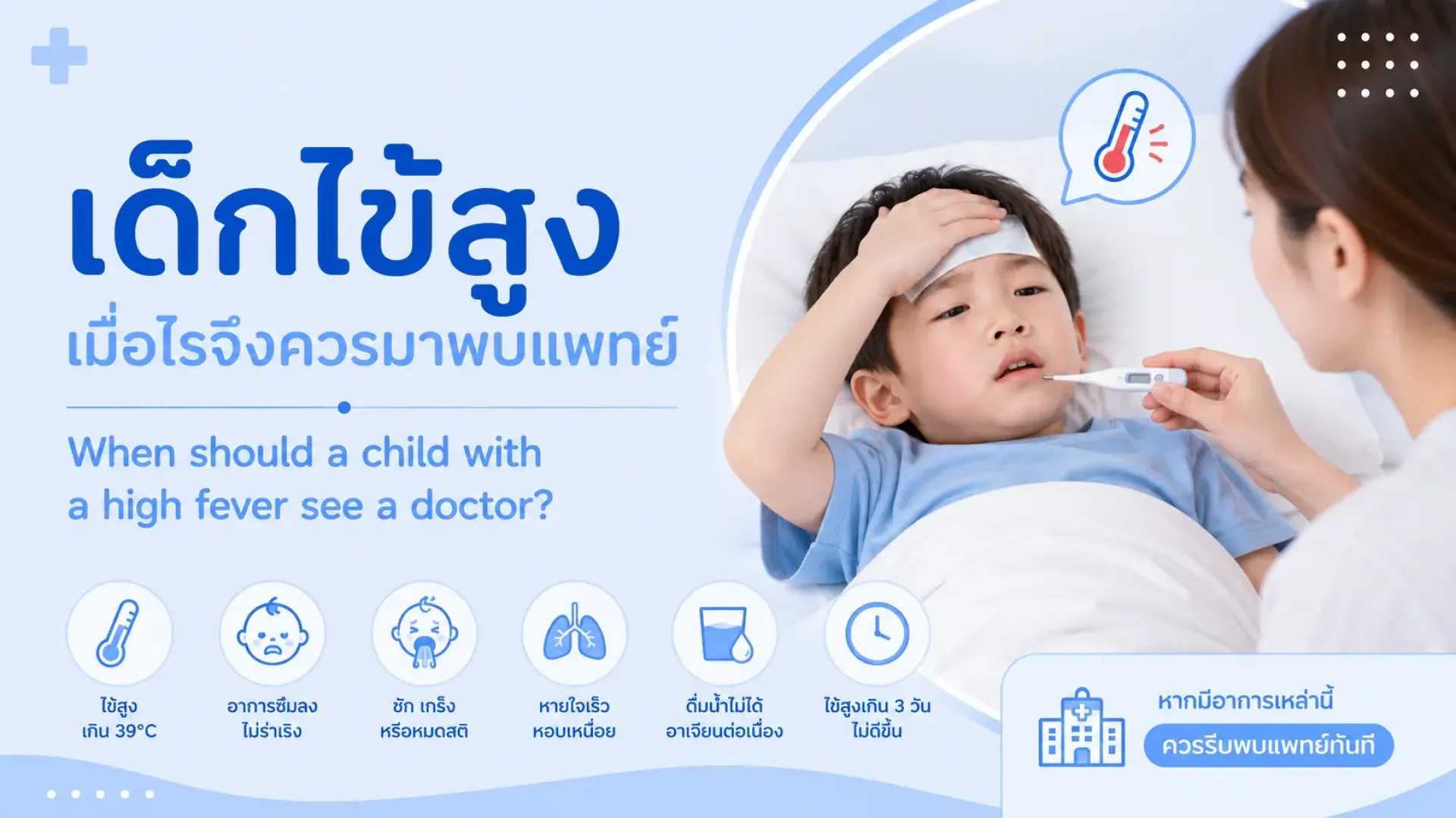
When Should a Child with a High Fever See a Doctor?
When a child develops a fever, spikes a high temperature, turns pale, becomes lethargic, or cries more fussily than usual, parents immediately feel anxious. The questions that follow are often: "Do we need to rush to the hospital?", "How high of a fever is dangerous?", or "Can we
just give fever medicine and wait to see how they do?"
The truth is, most fevers in children are caused by viral infections and usually improve on their own. However, in certain groups of children, a fever can be the first sign of a disease that requires rapid evaluation, such as sepsis, pneumonia, meningitis, urinary tract infections, dengue fever, or Kawasaki disease—especially in very young infants where external symptoms may not be clear initially.
International guidelines, such as the UK's NICE guideline, recommend assessing a febrile child by looking at the "risk of serious illness" rather than looking at the temperature reading alone. This is done by combining the overall picture of skin color, responsiveness, breathing, hydration status, neurological symptoms, and the child's age.
What is a Fever and at What Temperature is it Considered a Fever?
Generally, a child is considered to have a fever when their body temperature is 38 degrees Celsius (38°C) or higher. Temperature measurement should use an age-appropriate device, such as an axillary (underarm) measurement using a digital thermometer, or a tympanic (ear) measurement using a standardized device in children who are old enough. For very young infants, measurement and interpretation should be approached with extreme caution because a temperature that does not seem very high can carry greater medical significance than it would in an older child.
Generally, a child is considered to have a fever when their body temperature is 38 degrees Celsius (38°C) or higher. Temperature measurement should use an age-appropriate device, such as an axillary (underarm) measurement using a digital thermometer, or a tympanic (ear) measurement using a standardized device in children who are old enough. For very young infants, measurement and interpretation should be approached with extreme caution because a temperature that does not seem very high can carry greater medical significance than it would in an older child.
What parents need to understand is that a fever is a bodily reaction to an infection or inflammation; it is not a disease in itself. Therefore, the goal of care is not always to bring the fever number down as quickly as possible, but rather to assess whether the child still looks safe, can drink water, is breathing normally, has the energy to play or interact, and whether there are
accompanying danger signs.
High Fever in Children: The Danger Lies in
"Accompanying Symptoms" Rather Than the Fever Number
Some children may have a fever of 39°C, but after receiving fever reducers, they get up to play, drink water, breathe comfortably, and look well. In such cases, it may still be possible to closely monitor symptoms at home in the short term. Conversely, another child might have a fever of only 38.3°C but be highly lethargic, difficult to wake up, panting with blue lips, having cold hands
and feet, or not urinating for several hours. The latter scenario is clearly much more concerning. NICE states that in children older than 6 months, the height of the fever alone should not be used to determine whether a child has a serious illness; instead, all clinical signs should be considered together. On the other hand, infants under 3 months of age with a fever of 38°C or higher are considered a high-risk group for serious illness. Infants aged 3–6 months with a fever of 39°C or higher are considered to be at least in the intermediate-risk group and should be evaluated carefully.
Infants Under 3 Months: A Fever Means Seeing a Doctor
If your child is under 3 months old and has a measured fever of 38°C or higher, you should take them to see a doctor on that very day. Do not wait to monitor symptoms for long, even if the child does not seem very lethargic. The reason is that young infants in this age group can have serious infections while displaying minimal symptoms, such as feeding less, being unusually fussy, being too cold or too hot, breathing fast, or becoming more lethargic.
The American Academy of Pediatrics guideline for well-appearing febrile infants aged 8 to 60 days emphasizes a systematic evaluation based on age brackets. This is because the risk of a serious bacterial infection in young infants differs from that in older children, and some cases require blood tests, urine tests, or additional evaluations at the physician's discretion. In summary for parents: if your child is very young, especially under 3 months old, do not judge by external appearances alone. Seeking medical attention early in this group is the safer option.
Danger Signs That Require Immediate Hospitalization
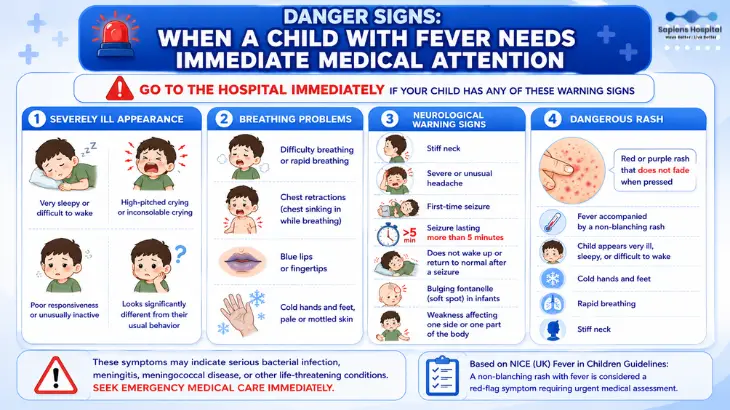
A child with a fever should receive urgent evaluation if they exhibit severe lethargy, are difficult to wake, do not respond normally, have a high-pitched cry or cry inconsolably, experience difficulty breathing, pant, have chest retractions, show blue lips, have mottled skin, cold hands and feet, look extremely pale, or seem "different" in a way that parents find distinctly unusual. Neurological symptoms are also critical signals, such as a stiff neck, unusually severe headache, a first-time seizure, a seizure lasting longer than 5 minutes, a seizure after which the child does not wake up or return to normal, a bulging fontanelle in infants, or localized weakness. These symptoms require an immediate medical examination as they could be related to severe infections or brain conditions.
Rashes are another matter of concern, particularly a red rash or blood spots that do not fade when pressed (non-blanching rash) accompanied by a fever, a child who looks very ill, a stiff neck, cold hands and feet, rapid breathing, or lethargy. The NICE guideline identifies a non-blanching rash combined with a fever as one of the signs indicating that a serious illness, such as meningococcal disease or certain severe infections, must be considered.
Fever Accompanied by Low Fluid Intake and Low Urine Output: Beware of Dehydration
Fever Accompanied by Low Fluid Intake and Low Urine Output: Beware of Dehydration
Children with a fever often lose their appetite, which by itself is not as dangerous as "being unable to drink fluids" or "a distinct decrease in urination." A child with a fever loses more fluid,especially if vomiting or diarrhea is also present. Signs of dehydration to watch out for include a very dry mouth, no tears when crying, sunken eyes, unusual thirst, lethargy, cold hands and feet, low urine output, or a diaper that remains dry for longer than normal.
The CDC explains that signs of severe dehydration in children can include severe lethargy or an altered level of consciousness, cold hands and feet, poor peripheral perfusion, and delayed capillary refill, which is considered a condition requiring urgent treatment. If your child has a fever and vomits every time they drink fluids, cannot take medication, has severe diarrhea, or has continuously low urine output, you should bring them to a doctor because young children can dehydrate much faster than adults.
The CDC explains that signs of severe dehydration in children can include severe lethargy or an altered level of consciousness, cold hands and feet, poor peripheral perfusion, and delayed capillary refill, which is considered a condition requiring urgent treatment. If your child has a fever and vomits every time they drink fluids, cannot take medication, has severe diarrhea, or has continuously low urine output, you should bring them to a doctor because young children can dehydrate much faster than adults.
Fever Lasting More Than 2 Days Without Improvement: Seek Physician Evaluation
If a child has a continuous fever for more than 48 hours without improvement, or if their condition seems to be progressively worsening, they should be taken to see a doctor—even if there are no clear emergency signs yet. This is because some illnesses may initially resemble a common cold but later begin to develop more specific symptoms, such as pneumonia, otitis media (middle ear infection), urinary tract infections, influenza, dengue fever, or localized bacterial infections.
The Royal Children’s Hospital Melbourne recommends seeking medical attention if an infant under 3 months has a fever, if the child looks sicker, does not improve after 2 days, is vomiting to the point of being unable to eat or drink, has a rash, has difficulty breathing, becomes lethargic, or if parents feel worried that the child does not seem normal.
A Fever Lasting 5 Days or More Should Not Be Overlooked
If a child has a continuous fever for 5 days or more, they should always be examined, even if the fever decreases during certain periods. This is necessary to evaluate for diseases that may require specific treatment, such as Kawasaki disease, which can present with a fever along with red eyes, red lips, a strawberry-like red tongue, a rash, swollen hands and feet, or swollen
lymph nodes—though young infants may not exhibit every single symptom. NICE states that children with a fever lasting 5 days or longer should be evaluated for Kawasaki disease, noting that infants under 1 year of age may not present with all symptoms but carry a higher risk of coronary artery abnormalities than older children.
In the Context of Thailand: Do Not Forget DengueFever
In Thailand, a child presenting with an acute high fever, especially a high continuous fever lasting 2–5 days, headache, severe body aches, loss of appetite, nausea, vomiting, abdominal pain, or a rash, should always raise suspicion for dengue fever. The dangerous phase of dengue fever is that sometimes children begin to cause concern when the fever starts to subside, not just during the highest peak of the fever.
The World Health Organization warns that warning signs for severe dengue include severe abdominal pain, persistent vomiting, rapid breathing, bleeding from the gums or nose, severe fatigue, restlessness, blood in vomit or stool, extreme thirst, cold skin, pallor, or severe weakness—all of which require immediate medical attention.
If dengue fever is suspected, parents should not purchase NSAIDs such as ibuprofen, aspirin, or certain pain relievers on their own without consulting a doctor, as these medications can increase the risk of bleeding. Fever reducers should be used according to medical advice, and symptoms should be monitored closely.
If the Fever Reducer is Given and the Fever Doesn't Drop, Should You Panic?
Fever-reducing medications are not always meant to make the fever disappear instantly. The primary purpose is to help the child feel more comfortable, drink fluids, rest, and reduce the distress caused by the fever. If a fever reducer is administered and the temperature number does not drop significantly, but the child becomes more refreshed, drinks fluids, breathes normally, and remains responsive, it is not an alarming sign by itself.
The Royal Children’s Hospital Melbourne recommends using paracetamol or ibuprofen when a fever makes a child uncomfortable, but aspirin should not be given to children unless prescribed by a doctor. Additionally, parents should not use cold water baths or sponge the child with very cold water, as this can cause shivering and increase discomfort.
However, if a fever reducer is given and the child still becomes lethargic, pants, cannot drink, vomits excessively, urinates very little, has cold hands and feet, develops an unusual rash, or if parents feel that "it's not just an ordinary fever," they should bring the child to a doctor without waiting for the next dose interval.
Febrile Seizures: What Should You Do?
Febrile seizures can occur in some children and usually happen during a rapid rise in temperature. The sight can be highly alarming for parents, but most febrile seizures do not cause long-term problems. However, there are certain situations where you must rush to the hospital immediately: a first-time seizure, a seizure lasting longer than 5 minutes, a child who does not wake up or return to normal consciousness after a seizure, recurrent seizures within the same illness episode, or accompanying symptoms like a stiff neck, severe lethargy, or abnormal breathing.
While a child is having a seizure, place them on their side in a safe area, clear away hard or sharp objects, do not pry the mouth open, do not force medications or water into the mouth, and keep track of the time. If the seizure lasts longer than 5 minutes or if breathing is abnormal, seek emergency medical assistance immediately.
When Can a Child Be Managed Temporarily at Home?
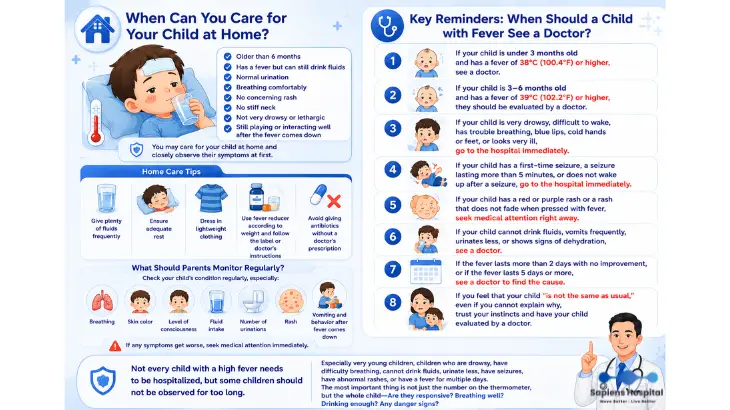
A child older than 6 months who has a fever but can still drink fluids, urinates normally, breathes comfortably, has no concerning rashes, no stiff neck, is not severely lethargic, and continues to play or interact well after the fever drops, can be managed at home under close observation initially. Home care should focus on offering fluids frequently, ensuring rest, dressing the child in clothing that is neither too thick nor too thin, and using fever reducers based on body weight and label instructions or medical advice. Avoid purchasing antibiotics on your own, as many fevers in children are caused by viruses, and antibiotics do not help viral infections clear faster. However, "managing at home" does not mean leaving the child unmonitored. Parents should check symptoms periodically, paying special attention to breathing, skin color, level of consciousness, fluid intake, urine frequency, rashes, vomiting, and behavior after the fever drops. If the condition changes for the worse, bring the child to see a doctor immediately.
Easiest to Remember: When Should a Febrile Child See a Doctor?
- If the child is under 3 months old and has a fever of 38°C or higher, see a doctor.
- If the child is 3–6 months old and has a fever of 39°C or higher, they should be evaluated.
- If the child is severely lethargic, difficult to wake, has difficulty breathing, blue lips, cold hands and feet, or looks very ill, go to the hospital immediately.
- If there is a first-time seizure, a seizure lasting longer than 5 minutes, or the child does not wake up, go to the hospital immediately.
- If there is a blood-spot rash or a rash that does not fade when pressed accompanied by a fever, seek medical attention immediately.
- If the child cannot drink fluids, vomits excessively, urinates very little, or shows signs of dehydration, see a doctor.
- If the fever lasts more than 2 days without improvement, or if there is a fever lasting 5 days or more, a doctor should investigate the cause.
- If parents feel their child "does not look the same," even if they cannot quite explain it, they should have a doctor evaluate the child, as parental instinct is often vital in caring for a sick child.
Not every child with a high fever needs to be hospitalized, but some children should not wait for symptoms to be monitored—especially very young infants, children who are lethargic, breathing abnormally, unable to drink, urinating little, having a seizure, developing an unusual rash, or having a fever for multiple days. The most important thing is not to look just at the numbers on
the thermometer, but to look at "the whole child" to see if they are still responding well, breathing well, drinking well, and if there are danger signs. For parents, if you are hesitating between "waiting to see" and "seeing a doctor," bringing the child in for an evaluation is usually the safer choice—especially when the child is very young or symptoms change rapidly. In certain infectious diseases, early diagnosis and treatment can significantly alter the outcome.
SapienS Hospital
SapienS Hospital
Move Better: Live Better
Tel. 02-111-3703
References
National Institute for Health and Care Excellence. Fever in under 5s: assessment and initial management. NICE Guideline NG143. 2021.
Pantell RH, Roberts KB, Adams WG, et al. Evaluation and Management of Well-Appearing Febrile Infants 8 to 60 Days Old. Pediatrics. 2021;148(2):e2021052228.
The Royal Children’s Hospital Melbourne. Clinical Practice Guidelines: Febrile child.
The Royal Children’s Hospital Melbourne. Kids Health Info: Fever in children.
Centers for Disease Control and Prevention. Oral Rehydration, Maintenance, and Nutritional
Therapy: The Management of Acute Diarrhea in Children. World Health Organization. Dengue and severe dengue: fact sheet.
Related Content
Discover how to safely manage Hand, Foot, and Mouth Disease (HFMD) at home with practical care and dietary tips. Learn to identify early symptoms and spot the critical warning signs, such as severe dehydration, that require immediate medical attention.
10 Jul 2026
Is your child suffering from diarrhea and vomiting? Learn how to spot early signs of severe dehydration and manage fluid loss safely at home.
10 Jul 2026

As your child starts school, their world expands—and so does their exposure to germs! Let's check their vaccine book for the essential shots needed to keep your little one safe and protected.
10 Jul 2026
